






What Makes Up the Cost of Sending Money to Vietnam?

The cost of sending money to Vietnam has two parts: the fee you are quoted and the exchange rate margin you are not—the gap between the market rate and the rate your provider actually applies. The World Bank puts the global average cost of sending $200 at 6.36% in Q3 2025, and most of that figure does not sit in the "transfer fee" line.
Most senders compare only the advertised fee. That is why the amount reaching family in Vietnam so often falls short of what was expected, even with a provider advertising low fees.
This article breaks down each cost inside a transfer to Vietnam, identifies the largest one that usually goes unnoticed, sets out the World Bank benchmarks you can measure any quote against, explains the new 1% tax on transfers from the United States, and looks at the final payout stage inside Vietnam.
This article covers money flowing into Vietnam from abroad. It is written for people sending to family in Vietnam and for institutions handling that flow.
1. What actually makes up the cost of sending money to Vietnam
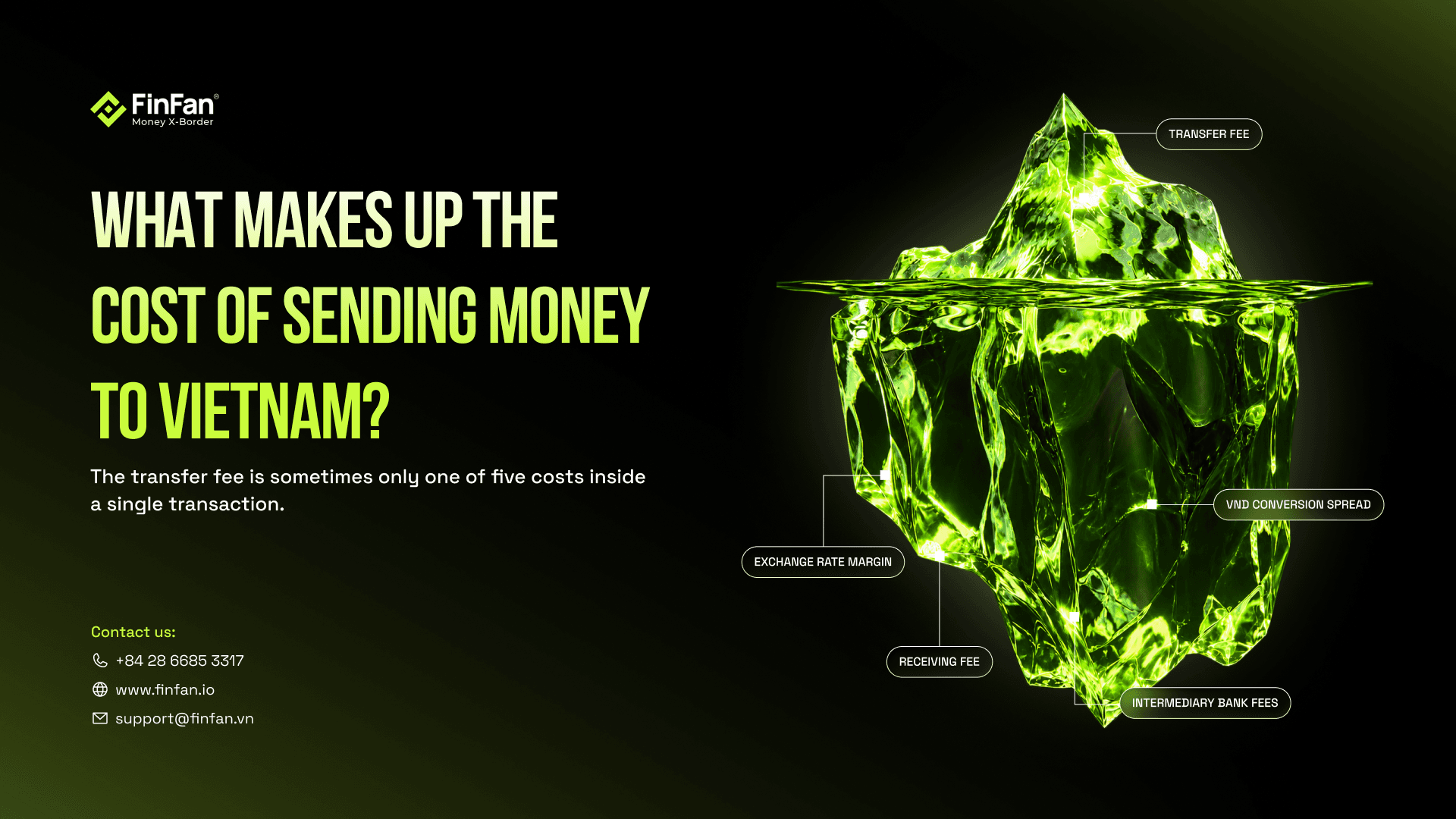
The cost of sending money to Vietnam is rarely a single charge. Five separate costs can attach to one transaction, and only the first is reliably disclosed before you commit.
 ![]
![]
Three of the five only become visible after the money lands. The sender sees a $5 charge, the recipient sees a shortfall, and nobody can point to where the difference went.
On intermediary banks. Transfers routed over SWIFT may pass through one or more correspondent banks before arriving. Each hop can deduct a flat charge. This is why two transfers of the same amount, sent the same day through the same bank, can arrive with different balances.
Some providers offer an option where the sender covers all charges along the route. It costs more upfront but guarantees the recipient gets the full amount, worth considering when the money has a fixed purpose such as tuition or a medical bill.
2. The exchange rate margin: the largest cost and the hardest to see
The largest component of the cost of sending money to Vietnam is usually the exchange rate margin, the gap between the mid-market rate and the rate your provider actually applies. It never appears as a line item. It is baked into the conversion.
The World Bank splits remittance cost into exactly two components—the transfer fee and the exchange rate margin—and publishes both for individual services on every corridor it tracks. The Vietnam corridor pages make the spread vivid:
- One cash-agent service on the United Kingdom to Vietnam corridor showed an exchange rate margin of 10.15% and a total cost of 14.78%
- One service on the Thailand to Vietnam corridor showed a margin of 11.90% and a total cost of 12.74%
- A digital service on the United States to Vietnam corridor showed a 0% margin, with the entire cost sitting in a transparent upfront fee
Same destination country. Three completely different cost structures. A provider advertising "no transfer fee" can easily be more expensive than one charging $5 if its margin is wider.
The 30-second check: look up the mid-market rate for your currency pair on an independent source, then compare it with the rate your provider is offering. Divide the difference by the mid-market rate. That percentage is your margin.
Why this matters more than people expect: transfer fees are often flat, so their weight falls as the amount rises. The margin is always a percentage. Send more, lose proportionally more.
That is why World Bank data shows the global average cost of sending $500 is 4.08%, well below the 6.36% recorded for $200. The flat fee gets diluted. The margin does not.
Corridor figures as published on the World Bank corridor pages. Services and prices change; check the current page for your route.
4. What a fair cost looks like: the World Bank benchmarks
You need an external yardstick to know whether what you are paying is normal or high.
The World Bank maintains Remittance Prices Worldwide (RPW), tracking thousands of services across 358 corridors and updated quarterly. It is the dataset the United Nations and the G20 use to measure progress on reducing global transfer costs.
General benchmarks, Q3 2025
 ![]
![]
How to read this: if your total cost exceeds 6.36%, you are paying above the global average. Below 3.29%, you are in the best tier available.
One important caveat on comparison. All of the benchmarks above are calculated for a $200 transfer. Because flat fees dilute as the amount rises, a larger transfer should be proportionally cheaper — the benchmark for $500 is 4.08%. If you send $1,000 and find your total cost is 5%, that is not "below average." That is expensive.
Cost by provider type
 ![]
![]
The gap between banks and money transfer operators is more than threefold. The World Bank records banks as consistently the most expensive provider type and consistently above the global average.
Cost by funding and payout method
Same corridor, different mechanics, materially different cost.
 ![]
![]
The most counterintuitive figure is the last one. Paying out to an account within the same bank as the sending bank averaged 13.91%, nearly four times the cost of a mobile wallet payout. The instinct that "the same bank must be cheaper" does not hold for cross-border transfers.
World Bank categories. The "mobile wallet" group in the underlying data covers both e-wallets and other mobile-account products, depending on the market.
Source for all figures in this section: World Bank, Remittance Prices Worldwide, Issue 54, September 2025 (Q3 2025 data).
4. How cost varies by sending country
The cost of sending money to Vietnam depends heavily on where you send from. Below are average costs for a $200 transfer from the markets with the largest Vietnamese communities, as at Q3 2025.
 ![]
![]
Japan is the outlier that matters. It recorded the largest increase among the major sending countries the World Bank groups together, and it is one of the largest labor markets for Vietnamese workers abroad. At 9.98%, it sits roughly 3.6 percentage points above the global average — about $7 on every $200 sent, purely from being on a more expensive route.
If you are in Japan, comparing providers is worth far more than it is for someone in Germany or the UK, where pricing is already competitive.
The wider trend is positive: the share of corridors priced below 10% has risen from 53% in 2009 to 83% in Q3 2025. Competition is working, but only for people who compare.
5. The new 1% US remittance transfer tax
This is the newest variable in the cost of sending money to Vietnam, and it applies only to transfers originating in the United States—historically the single largest source country for remittances to Vietnam.
Under the One, Big, Beautiful Bill Act, a 1% federal excise tax on certain remittance transfers took effect on 1 January 2026. According to the IRS, the tax applies when the sender provides cash, a money order, a cashier's check, or another similar physical instrument to the remittance transfer provider.
Key points from the IRS guidance:
- The sender is liable for the tax. Providers are required to collect it, make semimonthly deposits, and file quarterly returns.
- If the provider fails to collect it, the liability shifts to the provider.
- Treasury and the IRS issued proposed regulations on 10 April 2026, clarifying the amount the tax is imposed on and the full scope of physical instruments that trigger it. The public comment period closed on 12 June 2026.
- In October 2025, the IRS issued Notice 2025-55, granting limited penalty relief to providers that fail to deposit the correct amount during the first three quarters of 2026.
*What this means in practice. The tax attaches to how a transfer is funded, not to who the sender is. Cash-funded transfers at an agent counter fall within scope as described by the IRS. The statute and proposed regulations also include anti-conduit provisions intended to catch structured arrangements designed to sit outside it.
For a Vietnamese family receiving support from a relative in the United States, 1% is small next to a 10% exchange rate margin. But it is real, it is new, and it stacks on top of everything else in this article.
This section describes federal tax rules that are still being finalized. The proposed regulations are not final, and details may change. This is general information, not tax advice. If you send money from the United States regularly, speak to a qualified tax professional about your situation.
6. How the payout stage inside Vietnam affects cost
Cost accumulates across the whole journey, not just at the start. A cross-border transfer moves through three stages: origination abroad, cross-border settlement, and payout inside Vietnam. Senders compare the first stage. The third stage determines most of the speed and part of the cost.
The benchmark data above shows how much difference the final stage makes: on the same corridor, a mobile wallet payout averaged 3.92%, a bank account payout 7.86%, and a payout to an account at the same bank as the sender 13.91%. The payout method at the Vietnam end can produce a threefold difference in cost with everything else held constant.
Payout in Vietnam is handled by two categories of institutions: credit institutions, and economic organisations licensed to provide foreign currency receipt and payment services. By volume, the second group handles considerably more. According to the State Bank of Vietnam's Region 2 branch, remittances to Ho Chi Minh City reached more than $10.34 billion in 2025, up 8.3% year on year. Of that:
- $7.43 billion (71.8%) moved through economic organisations
- $2.92 billion (28.2%) moved through credit institutions
Ho Chi Minh City consistently accounts for around 60% of the national total, so this structure reflects the wider picture. Asia alone contributed close to $5.06 billion, or 48.9%, largely from established labor markets, including Japan, South Korea, and Taiwan.
Why does this affect cost? The broader and more automated the domestic payout network, the fewer manual steps, reconciliation cycles, and delays in the final stage. A transfer credited straight to a recipient's bank account or e-wallet has a fundamentally different cost structure to one that passes through several intermediate handling steps.
FinFan (Nhat Phuong Joint Stock Company – Best Way Corporation) operates in this third stage. FinFan does not take transfer instructions directly from senders abroad. It provides the technology and payout network that allows international money transfer operators and banks to complete delivery to recipients in Vietnam through bank accounts and e-wallets.
For international money transfer operators evaluating payout partners in Vietnam, the quality of this stage flows straight through to the cost and experience their own customers receive.
Frequently asked questions
Does the recipient in Vietnam pay income tax on money received from abroad?
Under Clause 7, Article 4 of Personal Income Tax Law No. 109/2025/QH15, effective 1 July 2026 (as amended by Law No. 09/2026/QH16), income from remittances is exempt from personal income tax in Vietnam. Implementing guidance is set out in Decree 253/2026/ND-CP and Circular 87/2026/TT-BTC, both effective 1 July 2026, which replaced Circular 111/2013/TT-BTC. Confirm the documentation required for your own circumstances with the tax authority or the paying institution.
Why did my recipient get less than I sent?
Three usual causes: an exchange rate margin that was never disclosed, intermediary bank fees deducted from the principal in transit, and a receiving fee at the Vietnam end. To ensure the full amount arrives, choose a provider that quotes the final received amount, or select the option where the sender covers all charges.
Does sending a larger amount reduce the cost?
Proportionally yes, but less than most people assume. Flat fees dilute as the amount rises, but the exchange rate margin is a percentage and does not move. That is why the average cost of sending $500 falls to 4.08% rather than towards zero.
Are banks a safer way to send money to Vietnam?
Every official channel has reconciliation and documentation. On cost, World Bank data shows banks are the most expensive provider type at an average of 14.99%, against 4.72% for money transfer operators. The thing to verify is not the category of institution but whether it is properly licensed in both the sending and the receiving country.
Does the new 1% US tax apply to every transfer from the United States?
No. Per IRS guidance, it applies to transfers where the sender provides cash, a money order, a cashier's check, or a similar physical instrument. The proposed regulations issued in April 2026 clarify the scope and are not yet final. Consult a qualified tax professional about your own transfers.
How long does money take to arrive in Vietnam?
It depends on the channel. World Bank data records bank services as materially slower than money transfer operator and mobile operator services across every region. Actual timing depends on the corridor, the payout method, and any verification steps triggered.
Conclusion
The cost of sending money to Vietnam is rarely the number on the screen. It sits in the gap between what you send and what actually reaches your family in VND — and the exchange rate margin usually accounts for most of that gap.
Before your next transfer: check the market rate on an independent source, ask the provider to quote the final VND amount the recipient will receive, then measure the total against the 6.36% global benchmark and the 5.83% East Asia & Pacific average. If you are sending from the United States, check how you are funding the transfer.
And whichever provider you choose, use official channels only: banks, licensed international money transfer operators, and institutions authorised to provide foreign currency receipt and payment services. Unofficial channels may quote lower prices, but they offer no protection, produce no documentation evidencing the source of funds, and carry legal risk for both sender and recipient.
Contact FinFan today so our team will guide you to fast, secure financial solutions.
- Website: https://finfan.io
- Email: support@finfan.vn
- Phone: +84 2866.853.317
Read next:
- How long does It take to receive money from abroad in Vietnam?
- Documents to prepare when receiving money from abroad
Sources:
- World Bank, Remittance Prices Worldwide, Issue 54, September 2025 (Q3 2025 data)
- World Bank, Remittance Prices Worldwide — Methodology and Vietnam corridor pages
- IRS, Treasury, IRS issue proposed regulations on the new remittance transfer tax, IR-2026-48, 10 April 2026; IRS Notice 2025-55
- State Bank of Vietnam, Region 2 branch — Ho Chi Minh City remittance data, 2025
- Personal Income Tax Law No. 109/2025/QH15
- Law No. 09/2026/QH16 amending the Personal Income Tax Law
- Decree 253/2026/ND-CP
- Circular 87/2026/TT-BTC
FinFan is a brand of Nhat Phuong Joint Stock Company (Best Way Corporation), operating in foreign currency receipt and payment services for funds flowing from abroad into Vietnam, in cooperation with banks and international money transfer operators. FinFan is not a bank, does not take deposits, and does not provide services for sending money from Vietnam to other countries. This article is general information, not financial, tax or legal advice. All figures are cited with their publication date and are subject to change.

Dr. Tuyen Nguyen
Money Beyond Borders