






How Long Does It Take to Receive Money from Abroad in Vietnam?


Receiving money from abroad in Vietnam takes anywhere from a few minutes to five business days, depending on the channel. But that range is misleading: according to SWIFT network data, 75% of payments travelling over the Swift network reach the beneficiary bank within 10 minutes, and over 90% within an hour.
In other words, the international leg is rarely the cause. Most of the waiting happens in the final domestic stage, where cut-off times, business-day cycles, compliance screening, and manual processing come into play.
This article covers the real timings by payout channel, the seven things that actually cause delays, the international benchmarks for what counts as normal, and what to do at each stage when the money has not arrived.
Quick answer: timings by payout channel
Timing depends mainly on how the money is paid out at the Vietnam end, not on geographic distance.

The key point: the gap between "a few minutes" and "five business days" is not about messaging technology. It comes down to the operating model at the final stage, specifically whether the paying institution pre-funds or waits for the money to actually land.
This is also why World Bank data records money transfer operator and mobile operator services as materially faster than bank services in every region: most non-bank providers pre-fund transactions, so the recipient has the money before cross-border settlement completes.
Why "SWIFT takes 2 to 5 days" is the wrong conclusion
Most articles on this topic stop at "a SWIFT transfer takes 2 to 5 business days." That describes the experience accurately but attributes it to the wrong cause.
According to published SWIFT data, 75% of payments over the Swift network reach the beneficiary bank within 10 minutes, many arrive in seconds, and over 90% arrive within an hour.
The more important figure sits elsewhere. Also, according to SWIFT, the international leg accounts for less than 20% of a payment's total journey on average. Around 80% of total processing time sits in the last mile, after the money has reached the final financial institution and before it is checked, processed, and credited to the recipient. Swift is explicit about what stretches this stage: regulatory reporting requirements, operating hours, foreign exchange controls, and manual processing at the beneficiary institution.
A cross-border transfer moves through three stages:
- Origination abroad: The sender places the instruction, and the provider verifies and collects the funds
- Cross-border messaging and settlement: This stage is usually measured in minutes
- Payout in Vietnam: Crediting the account or wallet, or paying out cash to the recipient
Stage 2 is rarely the bottleneck. Stage 1 and, above all, stage 3 are where the time goes. Understanding this changes how you choose a provider: The question to ask is not "Which network does this service use?" but "How will the money actually be paid out in Vietnam?"
Seven things that actually cause delays

On cause 4. Compliance screening is not a fault in the system; it is a required step that protects both sender and recipient. The most effective way to make it pass smoothly is to provide complete, accurate details that match identity documents from the outset, not to look for ways around it.
On cause 5. This is the most common delay and also the most preventable. The recipient's name must match their identity document exactly: no diacritics, correct order. A single wrong character in an account number or bank code is enough to hold the transfer.
A warning: if a service promises instant delivery with no verification whatsoever or suggests moving money outside official channels, stop. Unofficial channels offer no protection, no documentation evidencing the source of funds, and carry legal risk for both parties.
What counts as normal? International benchmarks
You need an external yardstick to know whether your transfer is fast or slow relative to the market.
Since 2020, the G20 and the Financial Stability Board (FSB) have set quantitative targets for cross-border payments, with remittances tracked as a separate segment with its own indicators.

In its consolidated progress report published on 9 October 2025, the FSB concluded that satisfactory improvement at the global level is unlikely to be achieved in line with the 2027 timetable and stressed the need for stronger action at the regional and national levels.
How to read these numbers:
- Money arriving within an hour: your transfer is in the fast group, alongside roughly 54% of remittance transfers globally.
- Money arriving within one business day: normal and in line with industry standards.
- Beyond five business days: unusual and worth investigating.
The five-day mark is not arbitrary. Under the World Bank's SmaRT indicator, a service only qualifies for the cheapest group if its processing speed is five days or less.
Sources for this section: Financial Stability Board, G20 Roadmap consolidated progress report, October 2025; Swift; World Bank, Remittance Prices Worldwide.
The Vietnam factor: Tet peak season and holidays
This is a variable no international dataset captures, yet it directly affects millions of transfers each year.
Remittances to Vietnam are strongly seasonal. Peak season typically runs for about a month before and after Tet, the Lunar New Year, with significant increases in both transfer volume and average transfer size.
Two practical consequences:
- Volume spikes lengthen processing time at the verification and reconciliation stages, even on channels that are normally very fast.
- The extended Tet holiday breaks the chain of business days. A transfer committed to 2 business days, placed just before the holiday, can take more than a week in calendar terms.
If the money has a fixed deadline (new year gifts, medical costs, tuition), send it at least five business days earlier than you normally would during the run-up to Tet. The same principle applies to long public holidays in Vietnam and to non-working days in the sending country.
Money hasn't arrived? What to do at each stage
Before contacting anyone, have these ready: the transaction reference from the sender, the amount and currency, the date and time the instruction was placed, and the name of the service used. For SWIFT transfers, the unique reference (UETR) allows the status to be traced along the whole route.

An important principle: a trace request usually has to be initiated by the sender because they are the party with the contract with the provider. A recipient in Vietnam has little ability to trace directly without the transaction reference.
If a transfer is returned, the funds normally go back to the sender's account after deduction of charges already incurred along the route, which is one more reason to check the details carefully at the outset.
Five ways to shorten the wait
- Ask how the money will be paid out in Vietnam, not just which network the provider uses. This determines most of the waiting time.
- Get the recipient details exactly right the first time: unaccented name matching the identity document, correct account number, and correct bank code.
- Place the instruction during business hours, early in the week. A Friday afternoon instruction, or one placed after the cut-off, will almost certainly roll to the next business day.
- Complete identity verification before you need the money. On a first transfer, verification is usually the longest step, and it only has to be done once.
- Send early in peak season. Around Tet and long holidays, add at least five business days to your normal expectation.
Frequently asked questions
Can money arrive in Vietnam on the weekend?
It depends on the channel. Mobile wallet and card payout channels generally operate continuously, so funds can arrive on the weekend. Transfers running through the banking system on a business-day cycle are typically processed on the next business day.
Do larger amounts take longer?
They can. Higher-value transfers often trigger additional checks and requests for documents evidencing the purpose of the transfer. This is routine, not a sign that something is wrong. Having the relevant paperwork ready shortens the process considerably.
Why is it slower this time, using the same service as before?
Three common explanations: the instruction fell after a cut-off or before a nonworking day, the transfer was routed through a different correspondent bank than last time, or it was pulled into manual compliance review. None of these means the money is lost.
Can the recipient track the transfer themselves?
Not easily without the transaction reference. Ask the sender to share it as soon as the instruction is placed. For SWIFT transfers, the UETR allows the status to be traced along the whole route.
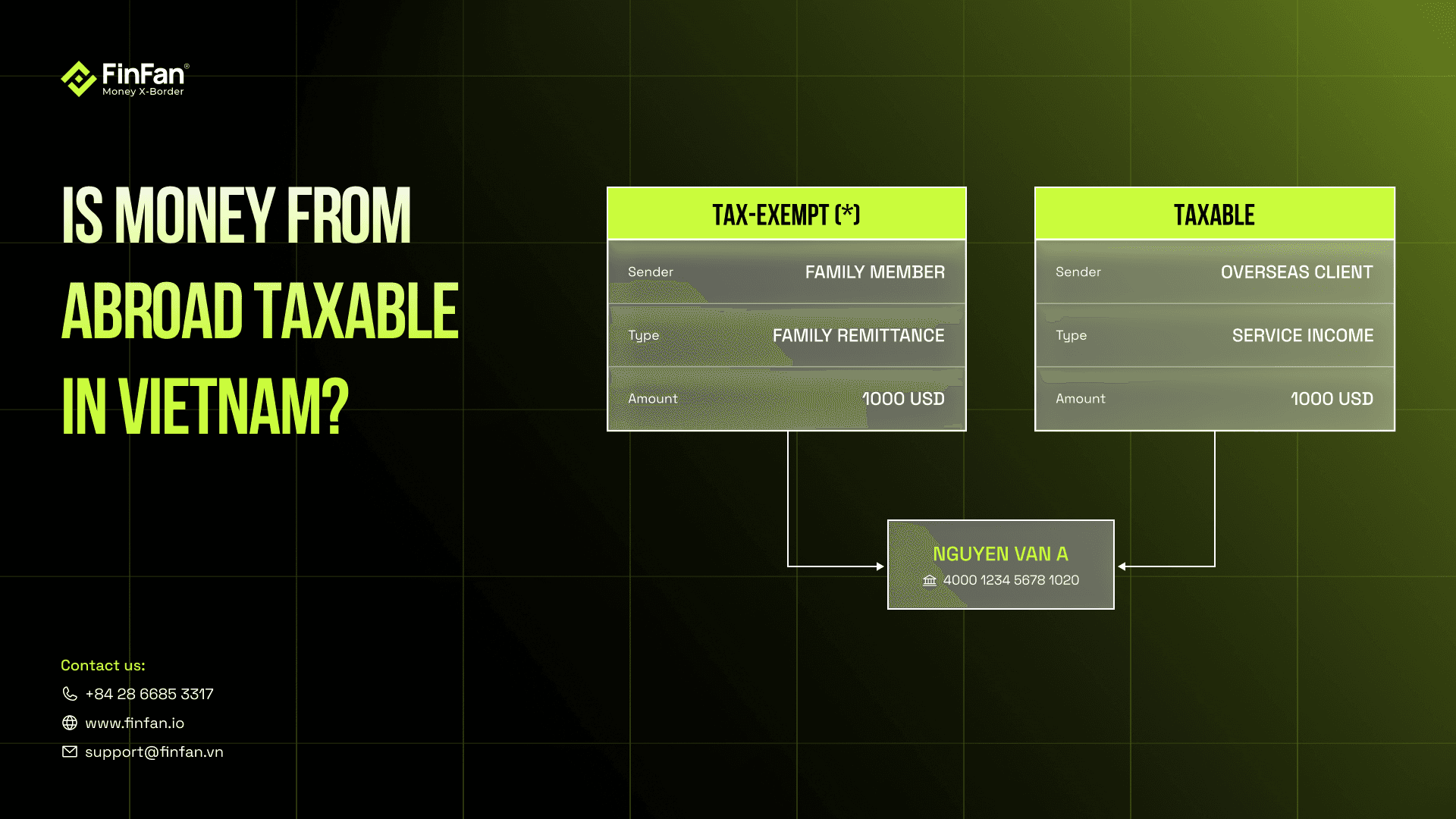
Does the recipient in Vietnam pay income tax on money received from abroad?
Under Clause 7, Article 4 of Consolidated Document No. 112/VBHN-VPQH dated 20 May 2026, issued by the Office of the National Assembly, consolidating Vietnam's Personal Income Tax Law, income from remittances is exempt from personal income tax. Confirm the documentation required for your own circumstances with the tax authority or the paying institution.
Conclusion
How long does it take to receive money from abroad in Vietnam? The short answer is a few minutes to five business days. The more useful answer: the waiting has almost nothing to do with the international leg, and almost everything to do with how the money is paid out inside Vietnam.
Before your next transfer: ask how the payout works at the Vietnam end, check the recipient details character by character, place the instruction during business hours early in the week, and get the reference number as soon as it is sent.
Contact FinFan today so our team will guide you to fast, secure financial solutions.
- Website: https://finfan.io
- Email: support@finfan.vn
- Phone: +84 2866.853.317
Sources:
- Financial Stability Board, G20 Roadmap for Enhancing Cross-border Payments
- World Bank, Remittance Prices Worldwide, Issue 54, September 2025
- Consolidated Document No. 112/VBHN-VPQH, 20 May 2026, Personal Income Tax Law
- Swift, How long does a Swift payment take?
- Swift, Unlocking last mile speed in cross-border payments
FinFan is a brand of Nhat Phuong Joint Stock Company (Best Way Corporation), operating in foreign currency receipt and payment services for funds flowing from abroad into Vietnam, in cooperation with banks and international money transfer operators. FinFan is not a bank, does not take deposits, and does not provide services for sending money from Vietnam to other countries. Timings in this article are general market references, not a service commitment. This content is general information, not financial, tax or legal advice.

Dr. Tuyen Nguyen
Money Beyond Borders