






Is Money Received From Abroad Taxable in Vietnam?

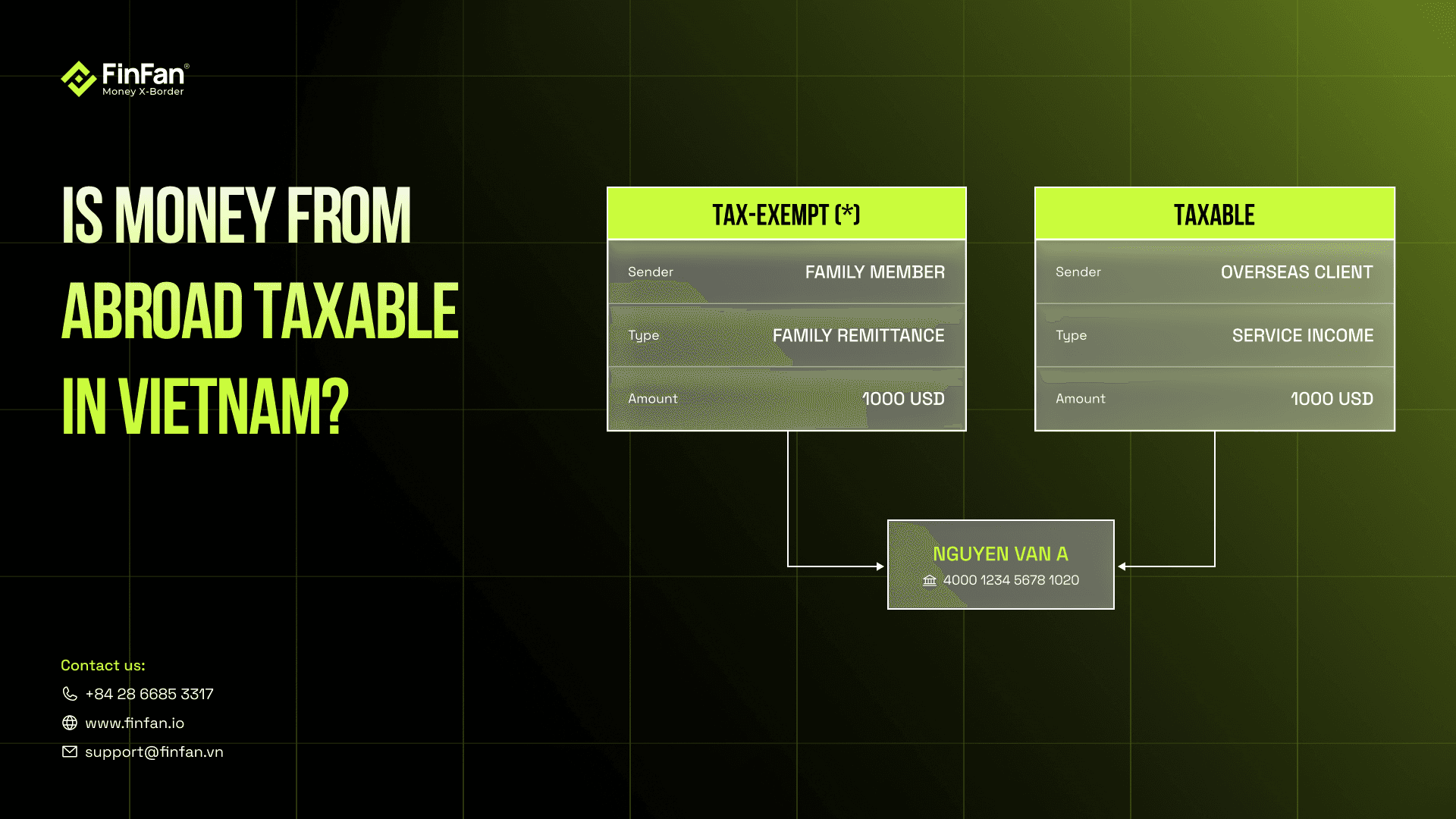
Is money received from abroad taxable in Vietnam? The answer depends on the nature of the money, not on the fact that it crossed a border. If the funds are a remittance sent by a relative living abroad, they are exempt from Vietnamese personal income tax. If they are payment for work you performed or goods you sold, they are taxable income.
That distinction trips up a great many people. A freelancer receiving a transfer from a client in the United States and a daughter receiving money from her mother in Japan both see the same line on a bank statement. Their tax positions are completely different.
This article sorts the common situations into clear categories, explains which ones are exempt, which ones require filing, and what documentation to keep. It is based on the legislation currently in force: Personal Income Tax Law No. 109/2025/QH15 and Decree 253/2026/ND-CP, which replaced the previous framework on 1 July 2026.
The short answer
Three categories cover almost every inbound transfer received by an individual in Vietnam.

The point to remember is that the same sender, using the same channel, into the same account, can produce two different outcomes depending on why the money was sent. Vietnamese tax authorities look at the substance of the income, not the transfer mechanism.
What changed on 1 July 2026
This is the section most existing guidance has not caught up with. If you are reading an article that relies on Circular 111/2013/TT-BTC or Decree 65/2013/ND-CP, it no longer reflects the framework in force.
The current instruments are:
- Personal Income Tax Law No. 109/2025/QH15, passed by the National Assembly on 10 December 2025 and subsequently amended by Law No. 09/2026/QH16. It comprises four chapters and 29 articles and took effect on 1 July 2026. Provisions concerning business income and employment income of resident individuals apply from the 2026 tax period.
- Decree 253/2026/ND-CP, issued on 30 June 2026 and effective 1 July 2026, which sets out the implementing details. This decree replaced Decree 65/2013/ND-CP.
For the question of inbound funds, the two provisions that matter are Article 4, Clause 7 of the Law, which places remittance income in the exempt category, and Article 25 of Decree 253/2026/ND-CP, which sets the conditions for that exemption.
What actually counts as a remittance
This is where the common misunderstanding sits. "Money from abroad" and "remittance" are not interchangeable. Remittance is a narrow concept with a specific legal definition.
Under Article 25 of Decree 253/2026/ND-CP, the exemption covers two situations.
- The first situation is money received from abroad from a relative who is a Vietnamese national settled overseas or a Vietnamese national working on assignment or studying abroad and sent to a relative in Vietnam.
- The second situation is money received from abroad from a relative who is a foreign national, which is also exempt provided it meets the conditions on encouraging inbound transfers set by the State Bank of Vietnam.
Those conditions sit in Decision 170/1999/QD-TTg of 19 August 1999, as amended by Decision 78/2002/QD-TTg and consolidated in Document 06/VBHN-NHNN of 25 November 2013. Article 1 provides that foreign nationals transferring money into Vietnam to support family or relatives, or for charitable purposes, are encouraged on the same terms as overseas Vietnamese. Article 6, clause 3 confirms that the recipient pays no income tax on foreign currency received from abroad.
That second situation did not exist under the previous rules. It matters in practice for mixed-nationality families, for Vietnamese nationals married to foreign spouses, and for cases where a foreign son-in-law or daughter-in-law sends support to relatives in Vietnam.
Two conditions are implied in both situations:
- A family relationship. The sender must be a relative of the recipient. Money from a friend, a business contact, or an organization does not qualify under this article.
- No exchange of value. This is support, not payment for goods or services. If a "relative sends you money" but the substance is compensation for work you did for them, the amount is employment income.
Inbound funds that are not remittances and are taxable
If the money you receive is consideration for labor, services, or goods, it is taxable income regardless of the channel it arrived through.
- Employment income. This includes salary from a foreign employer. It also includes, under Article 8, clause 2(c) of Decree 253/2026/ND-CP, remuneration received for services provided by an individual who is not registered for business, whether or not that individual holds a professional license or certificate. That category captures freelancers, contractors, and remote workers.
- Business income. Article 7 of the decree explicitly lists income from e-commerce activity and from platform-based business among the taxable categories. Sellers on international marketplaces, creators earning from content platforms, and affiliate marketers all fall here.
- Income from capital investment, capital transfer, royalties, and franchising arising abroad is likewise taxable for residents.
For employment income, the progressive schedule under Article 9 of Personal Income Tax Law No. 109/2025/QH15 was reduced from seven brackets to five.

Family circumstance deductions under Resolution 110/2025/UBTVQH15 are VND 15.5 million per month for the taxpayer and VND 6.2 million per month for each qualifying dependent.
The schedule is progressive by band, meaning that income falling within a bracket is taxed at that bracket's rate only. Reaching a higher bracket does not apply the higher rate to your whole income.
Two further points worth noting. First, individuals with business income at or below VND 500 million per calendar year are not subject to personal income tax on that business income. Second, where an organization pays an individual without a labor contract, or under a contract shorter than three months, withholding at 10 percent now applies from VND 5 million per payment, raised from the previous threshold.
Are you a tax resident? The question that sets the scope
Before calculating anything, establish your tax residency, because it determines which income Vietnam can tax.
Under Article 4 of Decree 253/2026/ND-CP, you are a resident individual if you meet either of two tests:
- You are present in Vietnam for 183 days or more in a calendar year, or across 12 consecutive months from your first day of presence. The day of arrival counts as one day and the day of departure counts as one day.
- You have a regular place of residence in Vietnam, meaning registered permanent residence, or house lease contracts totalling 183 days or more in the tax year.
The consequences differ sharply:
- Residents are taxed on income arising both inside and outside Vietnamese territory, regardless of where it is paid or received.
- Non-residents are taxed only on income arising within Vietnamese territory.
This explains why a Vietnamese national living and working abroad for more than 183 days a year generally has no Vietnamese tax exposure on foreign earnings, while someone based in Vietnam working remotely for a foreign company does.
If you have already paid tax abroad on the same income, Article 6, clause 3 of Decree 253/2026/ND-CP allows the foreign tax paid to be credited against Vietnamese tax where Vietnam and the other jurisdiction have concluded a double taxation agreement. Vietnam has signed more than 80 such agreements. Claims follow the procedure set out in tax administration regulations and require proof of foreign tax residency together with evidence that the income was taxed abroad.
Other inbound funds that are also exempt
Beyond remittances, several categories are exempt and are rarely mentioned in general guidance. If your situation falls into one of these, the inbound funds do not create a personal income tax liability.
- Pensions paid from abroad. Article 27, clause 1 of Decree 253/2026/ND-CP exempts pension income, including when an individual living and working in Vietnam receives a pension paid by a foreign source. This is significant for overseas Vietnamese returning home after a working life abroad.
- Scholarships from foreign organizations. Article 28, clause 2, exempts scholarships received from domestic and foreign * organizations under those organizations' support programs, including any living allowance component.
- Wages of Vietnamese seafarers working for foreign shipping lines or for Vietnamese lines engaged in international transport (Article 32).
- Income from charitable organizations and funds established or recognized by a competent authority and operating on a not-for-profit basis (Article 30).
- Income from foreign aid for charitable or humanitarian purposes approved by a competent state authority (Article 31).
- Insurance compensation under life, non-life, and health insurance contracts (Article 29).
One frequent misconception concerns cash gifts. Article 15 of Decree 253/2026/ND-CP lists the inheritance and gift income that is taxable, and it comprises four asset classes: capital contributions, securities, real estate, and assets requiring ownership registration such as cars, vessels, and aircraft. Cash is not among them.
Documentation to keep
Being exempt under the law is one thing. Being able to demonstrate it when asked is another. Article 25, clause 3 of Decree 253/2026/ND-CP states that the basis for establishing exempt income is documents evidencing the source of funds received from abroad, together with the disbursing organization's payment records where applicable.
In practice, the following are worth retaining:
- Transaction records. Receipts, account statements, and transfer notifications from the disbursing institution, showing the sender, the amount, and the date.
- A clear transfer purpose. This is the practical detail most people overlook. A vague or inaccurate remittance reference is a common reason a transfer is queried and additional information is requested. Stating the purpose correctly at the outset saves considerable time later.
- Proof of family relationship for remittance claims. Household registration, birth certificates, marriage certificates, or equivalent documents.
- Proof of the sender's status. Passport, residence card, foreign employment contract, or study enrollment confirmation.
From practical experience in disbursement operations, most friction does not come from the nature of the funds. It comes from the file: a beneficiary name on the transfer instruction that does not match the identity document, incomplete sender details, or a transfer reference that does not state a clear purpose. Preparing the first three items above removes almost all of this category of delay.
Converting foreign currency for tax purposes
For taxable amounts received in foreign currency, the conversion rule has changed from the previous framework.
Under Article 17, clause 1 of Decree 253/2026/ND-CP, taxable income received in foreign currency is converted into Vietnamese dong at the buying rate of the commercial bank where the individual holds the transaction account, or where the paying organisation holds its account, at the time the income arises.
Where neither party holds an account in Vietnam, the applicable rate is the central rate of the Vietnamese dong against the US dollar, or the cross rate against another currency, as published by the State Bank of Vietnam at the time the income arises.
The previous rule used the average transaction rate on the interbank foreign exchange market. Several English-language guides still describe that older method. If you are working from one of them, update your calculation basis.
Frequently asked questions
My family sends me money every month. Do I need to declare it?
If the funds are a remittance from a relative abroad within the terms of Article 25 of Decree 253/2026/ND-CP, they are exempt income, and no personal income tax arises. You should still keep transaction records and proof of the family relationship so that you have supporting evidence available if it is ever requested.
Does a large amount get taxed?
The remittance exemption does not set a value threshold. What determines treatment is the nature of the funds and the relationship between sender and recipient, not the size of the transfer. Larger transactions may attract requests for additional information under anti-money laundering rules, but that is a verification procedure rather than a tax liability.
I am a freelancer paid by overseas clients. Does that count as a remittance?
No. Payment for services you provide is employment income or business income, depending on whether you are registered for business. It is taxable if you are a tax resident of Vietnam. Neither the nationality of the payer nor the transfer channel changes the character of the income.
I live abroad and send money home. Will my family be taxed on it?
No. The funds are exempt from personal income tax under Article 4, clause 7 of Personal Income Tax Law No. 109/2025/QH15. No tax is withheld from the recipient on a qualifying remittance. Any charges that arise are service fees of the transfer provider, not tax.
I already paid tax abroad on this income. What then?
If you are a tax resident of Vietnam with taxable income arising abroad, and Vietnam has a double taxation agreement with the jurisdiction concerned, the foreign tax paid can be credited against your Vietnamese liability in accordance with that agreement. Retain the foreign tax payment records as supporting evidence.
In summary
Receiving money from abroad does not automatically create a tax obligation in Vietnam. What determines the outcome is the nature of the funds: a remittance from a relative is exempt, while payment for labor, services, or goods is taxable income. Classifying the transfer correctly at the outset, and keeping a complete document file, prevents almost every problem that arises later.
A practical next step: identify which of the three categories in the table at the top of this article your incoming funds belong to, check that you hold both the transaction records and proof of family relationship, and make sure future transfers carry a clear statement of purpose.
For more complex situations, such as multiple income sources, income arising across several jurisdictions, or an uncertain residency position, contact your managing tax authority or a qualified tax adviser for guidance on your specific circumstances.
Contact FinFan today so our team will guide you to fast, secure financial solutions.
- Website: https://finfan.io
- Email: support@finfan.vn
- Phone: +84 2866.853.317
Sources:
- Personal Income Tax Law, consolidated document 112/VBHN-VPQH, Government Portal
- Decree 253/2026/ND-CP detailing the implementation of the Personal Income Tax Law
- Resolution 110/2025/UBTVQH15 on family circumstance deductions
- Consolidated Document No. 32/VBHN-NHNN dated 8 July 2016, State Bank of Vietnam, consolidating the circular guiding foreign currency receipt and disbursement services
- Consolidated Document No. 06/VBHN-NHNN dated 25 November 2013, State Bank of Vietnam, consolidating the Decision on encouraging overseas Vietnamese to transfer money home (consolidating Decision 170/1999/QD-TTg and Decision 78/2002/QD-TTg)
Disclaimer: FinFan is a brand of Nhat Phuong Joint Stock Company (Best Way Corporation), operating in foreign currency receipt and payment services for funds flowing from abroad into Vietnam, in cooperation with banks and international money transfer operators. FinFan is not a bank, does not take deposits, and does not provide services for sending money from Vietnam to other countries. Timings in this article are general market references, not a service commitment. This content is general information, not financial, tax or legal advice.

Dr. Tuyen Nguyen
Money Beyond Borders