


Virtual IBAN in Vietnam and How to Receive Payments Without an IBAN

An IBAN identifies an account in countries that use the IBAN standard. Domestic bank accounts in Vietnam do not have IBANs, but recipients can receive funds using the details required for a supported route. This guide explains IBANs, SWIFT/BIC, virtual identifiers and the information to confirm before receiving money from overseas. It also explains IRID separately, without treating IRID as an IBAN.
What an IBAN Is?
IBAN stands for International Bank Account Number. It is a standardised account identifier under ISO 13616, containing up to 34 letters and digits. An IBAN identifies an account; it is not itself a service for receiving funds.
The Structure of an IBAN
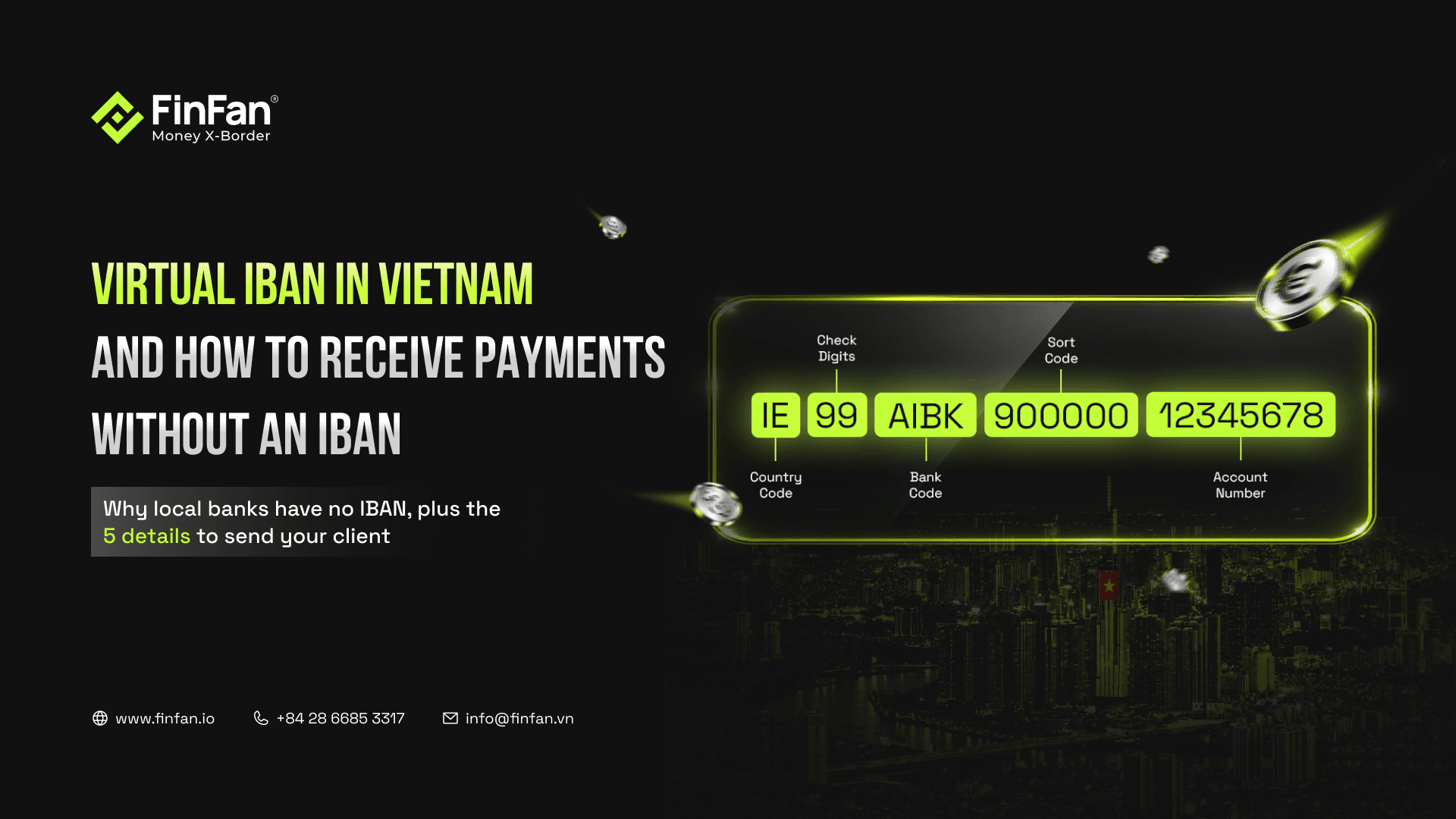
Each country sets its own IBAN length, but every IBAN has three parts in the same order:
- Country code: two letters, such as GB for the United Kingdom or DE for Germany.
- Check digits: two numbers that let systems catch input errors.
- Basic Bank Account Number (BBAN): the bank, branch, and account details in that country’s format.
A UK-format example is GB29 NWBK 6016 1331 9268 19, with 22 characters when spaces are removed. GB is the country code, 29 the check digits and NWBK the bank identifier. This illustrates the format only; do not use it to send money. Check digits help detect many input errors but do not prove that an account is active, belongs to the intended recipient or will accept a transfer.
Which Countries Use IBANs
Swift maintains the IBAN Registry of national formats that comply with ISO 13616. Use its current edition to check the format for a particular country, rather than relying on an undated country count.
- IBANs are widely used in Europe and parts of the Middle East.
- Other markets use their own account numbering and routing systems.
The United States, Canada, Australia and Vietnam do not use IBANs for domestic accounts. A sender in an IBAN country can still send funds to a market without IBANs, subject to the receiving bank’s supported route and instructions.
SEPA provides common rules for euro transfers. According to the EPC, its geographical scope covers 41 countries and territories, checked on 4 November 2026. The IBAN-only rule, where applicable, removes the need for the user to provide a BIC; it does not remove other required fields, including the beneficiary’s name. Some non-EEA routes may require a BIC. SEPA coverage is not identical to IBAN adoption, and this explanation does not establish that IRID supports a particular SEPA route.
IBAN vs SWIFT/BIC vs Local Account Numbers
These codes are often confused, but each identifies something different.

Swift is a financial messaging network. A BIC identifies an institution; an IBAN or account number identifies an account. These identifiers are not interchangeable. For a transfer to Vietnam, obtain the receiving bank’s complete instructions. Do not assume that every SEPA transfer requires the user to enter both an IBAN and a BIC.
Does Vietnam Use IBAN?
Domestic bank accounts in Vietnam do not have IBANs. When receiving through an international bank route using Swift, the recipient will generally need the domestic account number and the receiving bank’s SWIFT/BIC, plus any additional instructions. A Vietnam-based person receiving foreign account details does not make their Vietnamese domestic account an IBAN account.
What to Send Your International Client
For a direct transfer to a Vietnamese bank account through a supported route, request official receiving instructions. Basic details commonly include:
- the recipient’s full name, exactly as it appears on the account;
- the recipient’s account number;
- the bank’s name in English;
- the bank’s address;
- the bank’s SWIFT/BIC code.
Confirm the applicable SWIFT/BIC, currency and route with your bank. Additional information may include the beneficiary’s address, purpose, reference or intermediary-bank details. Never create an IBAN by adding a country code to a Vietnamese account number, and do not substitute a card number for an account number.
When a European Client Insists on an IBAN
Explain that your domestic Vietnamese bank account has no IBAN. A sender transferring directly to that account needs an international route supported by the bank, commonly Swift, rather than entering a Vietnamese account number into a SEPA form.
Before sending, confirm three practical points:
- Fees charged by the sending bank, receiving bank and any intermediaries; do not assume one route is always cheaper.
- Who bears each charge and whether deductions may apply; ask about the route-specific OUR, SHA and BEN options.
- Expected processing time, business days, cut-off times and verification steps that may affect receipt.
Share only details confirmed by the receiving bank or service provider. Agree on the currency, beneficiary name, reference and allocation of fees. If using another service for receiving foreign currency, verify the supported country, currency, sender type and route separately. A sender’s location in Europe does not itself establish SEPA eligibility.
What a Virtual IBAN Is
A virtual IBAN is a technical receiving identifier. It does not by itself establish that the user holds a separate bank account. General information about virtual IBANs must be distinguished from each provider’s product name and service scope; do not assume that IRID is an IBAN.
How Regulators Define a Virtual IBAN
The EBA’s May 2024 report identified inconsistent definitions and practices at that time. Regulation (EU) 2024/1624 (AMLR), Article 2(1)(26), subsequently defined a virtual IBAN as an identifier that redirects funds to an account identified by a different IBAN. The Regulation generally applies from 10 July 2027; do not present its requirements as already fully applicable in 2026.
A virtual IBAN may look like a conventional IBAN, so its appearance alone does not reveal the underlying account arrangements. Confirm the destination account, account holder, responsibilities and reconciliation process. The EBA also highlighted risks where end-user identification or transaction monitoring is insufficient.
How a Virtual IBAN Works
In some virtual IBAN models, separate identifiers route incoming funds to a master account and help allocate receipts to users. The underlying account structure and legal rights vary by arrangement. Avoid treating a familiar-looking identifier as proof of separate bank-account ownership or deposit protection.

A Virtual Account Is Not Always a Virtual IBAN
"Virtual account" is a market term used for several arrangements. In some models, separate receiving details help allocate funds credited to a master account. Do not assume that every virtual account is a separate bank account or that all virtual IBAN arrangements confer the same legal rights.
The format depends on the market where the account is issued:
- US receiving details may include an account number and a routing number for an eligible ACH or Fedwire route. Verify each route separately; these details are not an IBAN.
- In IBAN markets, some receiving-identifier arrangements may use virtual IBANs.
Ask about the exact receiving format, provider, beneficiary name, supported currency and route. The label “international account” alone does not establish these details or the user’s legal rights.
What to Check Before Using a Virtual Account or Virtual IBAN
Before sharing a virtual account number with a client, get clear answers to four questions:
- Whose name appears in the beneficiary details? Confirm the exact name and reference to use. A unique identifier alone does not establish that a separate bank account is held in your name.
- Which party provides each service and is responsible at each stage? Check the respective roles of the provider, bank and partners. A receiving identifier is not proof of authorisation or a guarantee of funds.
- How do funds reach Vietnam? Confirm the receiving currency, conversion steps, payout currency, withdrawal requirements, fees and expected timing.
- What documents must you submit, and what transaction records will you receive? Distinguish evidence supplied by you from confirmations provided by the institutions involved. Keep records for reconciliation and applicable obligations; do not assume that any confirmation meets all accounting or tax requirements.
How IRID Supports Receiving Foreign Currency in Vietnam
Freelancers, merchants and service exporters need accurate receiving details, visibility of transactions and a clear understanding of the amount paid out in Vietnam. IRID supports this process through a unique identifier and transaction-management functions on its platform.
IRID Is an International Receiving Identifier
IRID is an international receiving identifier developed by FinFan. Each customer receives a unique IRID code to help identify, track and reconcile transactions. Customers register and complete the required verification process. IRID should not be described as an IBAN or a bank account issued by FinFan.
- Through its partner network: IRID supports more than 30 currencies, converted into USD before reaching Vietnam.
- Outside that partner-network route: the supported receiving currencies are USD, CAD, AUD, EUR, GBP and SGD.
Use receiving details exactly as instructed. Confirm the currency, country, sender type and available route before sharing them with a client. Receiving an IRID code does not establish compatibility with every marketplace or international platform.
Fees and conditions depend on the service route. The current withdrawal schedule includes 0.7%, with a USD 25 minimum, for the listed Local routes, and 1.5%, with a USD 50 minimum, for SWIFT/Local Fedwire. Confirm the applicable route and related charges before proceeding; these figures do not establish the total cost of every transaction. Activation depends on the review of the submitted information; do not assume a fixed one-to-two-business-day timeline.
Request a Withdrawal to Receive VND in a Linked Domestic Bank Account
Users create a withdrawal request on IRID to receive VND through a domestic bank account linked to the platform. Processing, conversion, and payout follow the applicable service process. The ability to receive foreign currency does not establish foreign-currency withdrawal availability or automatic VND receipt without a withdrawal request.
Users declare the purpose and may need to provide sender, invoice, order or other supporting information. Check fees, exchange-rate information and transaction details against the current instructions. Transaction tracking and reconciliation functions do not replace accounting records or determine the tax treatment of an individual case.
Frequently Asked Questions
Can I calculate an IBAN for my Vietnamese bank account?
No. A domestic Vietnamese account number cannot be converted into an IBAN. Obtain official international receiving instructions from your bank instead of using an IBAN generator.
Does a unique receiving identifier mean I own a separate bank account?
Not by itself. Confirm the beneficiary name, institution providing the destination account and applicable terms. IRID is an international receiving identifier developed by FinFan.
Can I withdraw foreign currency because IRID supports multiple receiving currencies?
The confirmed payout process is VND to a linked domestic bank account after the user creates a withdrawal request. Receiving-currency support and payout currency are different aspects of the service.
Which details should my client use to send funds through IRID?
Use the exact receiving details and reference instructed for your case. If the client requests an IBAN or a particular route, confirm availability with FinFan first. Do not put an IRID code into an IBAN field.
Conclusion
IBAN identifies an account in countries using ISO 13616. Domestic Vietnamese bank accounts do not have IBANs. Virtual IBAN is a separate concept and is not an alternative product name for IRID.
Choose a receiving method by confirming the actual support available:
- For a direct transfer to a Vietnamese bank account, obtain the correct account number, beneficiary name, SWIFT/BIC and additional bank instructions.
- For IRID, confirm receiving details, currency scope, verification requirements, fees and the withdrawal process for VND payout to a linked domestic bank account.
A unique receiving identifier does not by itself determine bank-account ownership, processing speed or cost. Understand each party’s role, how funds reach Vietnam and the steps required before initiating a transaction.
Do you regularly receive foreign currency from overseas clients? Contact FinFan to learn about IRID registration, required information, and withdrawal requests for VND payout to a linked domestic bank account.
- Website: https://finfan.io
- Email: support@finfan.vn
- Phone: +84 2866.853.317
Disclaimer
IRID is developed by FinFan, the brand of Nhat Phuong Joint Stock Company (Best Way Corporation), to support receiving foreign currency and managing transactions. Users request withdrawals for VND payout to a domestic bank account linked to the platform. FinFan is not a bank and does not provide deposit services.
This article is for general information and does not replace legal, accounting or tax advice. Confirm the applicable scope, documentation, fees, exchange-rate information and processing times against current service instructions for your circumstances.
References
- Swift — IBAN standard and current national IBAN Registry
- EPC — SEPA geographical scope
- EPC — IBAN and BIC standards and the IBAN-only rule
- EPC — SEPA Credit Transfer customer-to-PSP implementation guidelines
- EBA — Report on virtual IBANs, May 2024
- European Union — Regulation (EU) 2024/1624, Articles 2 and 90
- EBA — Opinion and report on ML/TF risks, 2025, paragraphs 39–41
- Swift — Account and beneficiary verification versus format validation

Dr. Tuyen Nguyen
Money Beyond Borders