


Mass Payout API for Vietnam and How to Choose the Right Provider

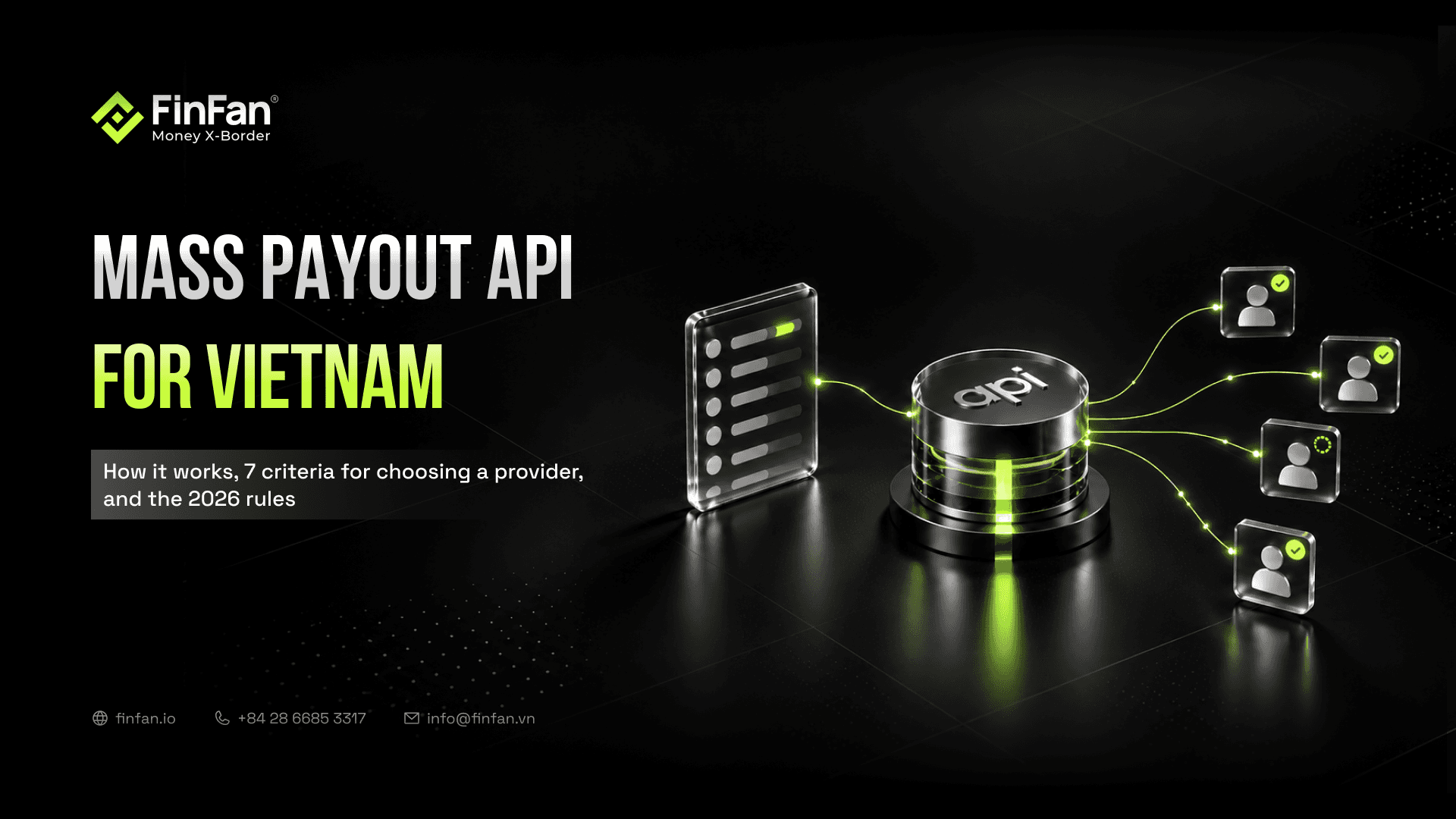
A mass payout API lets a business send money to hundreds or thousands of recipients through a few system calls instead of creating each transfer by hand. Marketplaces, gig platforms, affiliate programs, and companies with remote staff all need to pay out frequently, on time, and with data their finance teams can reconcile. In Vietnam, the task is more complex: recipients use bank accounts, e-wallets, and cash, and funds often originate abroad. This guide explains how a mass payout API works, which technical and compliance criteria to check, and the licensing framework that applies to payouts in Vietnam in 2026.
What a Mass Payout API Is
An API (application programming interface) connects two systems so they can exchange data and instructions. A mass payout API is a programmatic interface that lets your systems send bulk payments to many recipients through a single integration. It replaces manual bank transfers and CSV uploads.
Payment APIs vs Payout APIs
The two are often grouped, but they handle money moving in opposite directions.

When you evaluate providers, be clear about which direction you need. Many platforms are strong in only one.
Domestic Disbursements vs Cross-Border Payouts Into Vietnam
In the Vietnamese market, “mass payouts” covers two distinct models, with different funding sources and legal bases:
- Domestic disbursement: a business in Vietnam pays recipients in Vietnam in VND, for example, salaries or customer refunds. Banks and licensed payment intermediaries provide this service.
- Cross-border payouts into Vietnam: a business, platform, or money transfer operator (MTO) outside Vietnam pays recipients in Vietnam, for example, marketplace sellers, freelancers, affiliates, or remittance recipients. Funds arrive from abroad and are paid out through local channels.
Both models share most technical requirements. They differ in licensing and compliance, covered in the regulatory section below.
How a Mass Payout API Works
Every transaction starts with a payout request that carries the recipient’s details, the amount, and the transaction instructions. The API uses this data to initiate a transfer to the recipient’s bank account, card, or wallet. At scale, the flow expands into a pipeline.
From a Payout Batch to Individual Disbursements
A typical flow has five stages:
- Batch creation. Your system submits a list of recipients and amounts through the API.
- Validation. The provider checks data formats, payout channels, and recipient details before any funds move so that bad instructions are rejected early.
- Compliance screening. Each recipient and transaction goes through anti-money laundering (AML) and know-your-customer (KYC) checks.
- Routing and disbursement. Each instruction is routed to the right channel: bank transfer, e-wallet, or cash pickup.
- Result reporting. The API returns a status for every item (completed, pending, or failed), with error codes where relevant.
Transaction Status, Webhooks, and Reconciliation
At thousands of items per batch, manual checking is not an option. Mature payout APIs provide three mechanisms:
- Webhooks: the provider sends an HTTP POST to your endpoint whenever a payout clears or fails. Your system does not need to poll repeatedly.
- Status lookup endpoints: for checking a specific transaction on demand.
- Reconciliation reports: a unique identifier for every transaction, which you can store alongside your internal records and match against your general ledger.
Approval Workflows and Security Controls
Payout systems handle bank details, identity records, and large sums, which makes them a target for fraud. Three risk points matter most:
- API access and permissions: control who can call payout endpoints and from where.
- Payout approvals: require multi-level sign-off on batches above defined thresholds before release.
- Recipient account changes: flag and verify any change to a recipient’s bank or wallet details before the next payout.
Common Use Cases for a Mass Payout API
The business models that benefit most from automated payouts include:
- Marketplaces and e-commerce platforms settling seller revenue on a schedule.
- Gig and freelance platforms paying workers per task or per project.
- Affiliate and creator programs distributing commissions based on performance.
- Companies with remote staff paying salaries to people in other countries.
- Money transfer operators and fintechs that need a payout partner in the destination country to complete transfers for their customers.
- Treasury operations for businesses with cash flows across several markets.
What these models share is a large recipient base, small to mid-sized amounts per payment, and recurring frequency. These are exactly the conditions where manual processing is most costly and most error-prone.
How to Choose a Mass Payout API Provider for Vietnam
Assess providers against seven groups of criteria.
Payout Channel Coverage for Recipients in Vietnam
Recipients in Vietnam use bank accounts, e-wallets, and cash. An API that only supports bank transfers will miss recipients who rely on wallets or who live in areas where cash remains common. Check exactly which banks, wallets, and cash networks the provider connects to.
Payout Speed and Operating Hours
Ask three questions:
- Which channels settle in real time?
- Which channels settle in batches?
- Does the service run outside business hours, at weekends, and on public holidays?
For individual recipients, such as freelancers or remittance recipients, payout speed directly shapes their experience.
Pre-Payout Recipient Verification
A payout sent to the wrong account means investigation costs and sometimes unrecoverable funds. The API should support recipient checks before the payout is created to catch non-existent account numbers or names that do not match.
Idempotency and Error Handling
In API environments, a network interruption can leave your system unsure whether an instruction was received. The API should support idempotency keys: a unique identifier per instruction so that resending the same key results in only one transaction. You should also expect a clear error code set that separates retryable errors from errors that require corrected data.
Multi-Currency Funding and Transparent Exchange Rates
For cross-border payouts, multi-currency support is essential. Confirm three things:
- which currencies you can fund in
- how and when the conversion to VND takes place;
- whether the applicable rate is shown before you release a batch.
AML, KYC, and Security
Cross-border payouts require full AML, KYC, and transaction screening at the provider level. On security, check three points:
- the API authentication method;
- request signing;
- IP allowlisting.
Licensing and the Role of Each Party
This is the criterion foreign businesses most often overlook when entering Vietnam. Ask the provider two questions:
- Which activities is it authorized to perform?
- Which party actually pays the recipient?
A transparent provider will state its license clearly and explain the role of its partner banks and e-wallets.
The Regulatory Framework for Mass Payouts in Vietnam in 2026
The two payout models described above fall under two different sets of rules.
Domestic Disbursements Under Decree 52/2024/ND-CP
Decree 52/2024/ND-CP on cashless payments took effect on 1 July 2024. It classifies collection and disbursement support services (thu hộ, chi hộ) as payment intermediary services, alongside e-wallets and payment gateways. Non-bank organizations must obtain a license from the State Bank of Vietnam to provide payment intermediary services.
Businesses choosing a domestic disbursement partner should therefore verify that partner’s payment intermediary license or work directly with a bank.
Cross-Border Payouts Under Vietnam’s Foreign Exchange Rules
For economic organizations, receiving and paying out foreign currency from abroad rests on three main instruments:
- The Ordinance on Foreign Exchange of 2005, amended in 2013.
- Decree 89/2016/ND-CP, amended by Decree 23/2023/ND-CP, which sets the conditions for the State Bank of Vietnam to approve an economic organization to receive and pay out foreign currency directly. These conditions include a contract with a foreign partner for the service.
- Circular 34/2015/TT-NHNN, which guides the provision of foreign currency receiving and payout services. Circular 75/2025/TT-NHNN updated several procedural points from 31 December 2025.
For foreign partners, this means that a payout provider in Vietnam needs State Bank of Vietnam approval for this specific activity. A technology license or a standard business registration is not enough.
FinFan’s Approach to a Single API for Payouts in Vietnam
FinFan is the payout partner in Vietnam for more than 30 international money transfer operators, including MoneyGram and Remitly. FinFan is licensed by the State Bank of Vietnam for foreign currency acceptance and payment under License No. 973/GP-HCM, held since 2014. The license was renewed in 2017 and most recently under Decision No. 21/QD-HCM dated 10 January 2022.
Working with international partners, FinFan has found that the hardest part of paying recipients in Vietnam is not the technology. It is the number of integrations: each bank, each e-wallet, and each cash network has its own onboarding process.
Payout Channels Through One Integration
FinFan’s integration API connects all payout channels in Vietnam through a single API. International partners integrate once instead of connecting to each bank and each wallet separately.

On top of this API, FinFan’s mass disbursement service supports cross-border batch payouts for:
- payroll;
- marketplace seller settlements;
- freelancer and affiliate payouts;
- treasury operations.
Every transaction goes through full AML/KYC procedures. FinFan’s money transfer partner network covers more than 150 countries.
Clear Division of Roles
FinFan receives and routes payout instructions and connects to the payout channels. Partner banks and e-wallets credit the beneficiaries. For international partners, this division of roles sets out who is responsible at each step, from receiving the instruction to the moment funds reach the recipient.
Conclusion
A mass payout API replaces manual work with an automated pipeline: batch creation, recipient validation, compliance screening, routing to the right channel, and status reporting for reconciliation.
When choosing a provider for Vietnam, assess both technical capability and legal standing:
- channel coverage;
- payout speed and operating hours;
- idempotency and error handling;
- FX transparency;
- AML/KYC procedures;
- a license that matches the payout model you need.
For funds flowing from abroad into Vietnam, State Bank of Vietnam approval to receive and pay out foreign currency is the first thing to verify.
The fastest way to plug into Vietnam. If you are an international money transfer operator, fintech, PSP, or digital platform that needs to pay recipients in Vietnam, the FinFan team can walk you through channel coverage, the integration process, and compliance requirements.
- Website: https://finfan.io
- Email: support@finfan.vn
- Phone: +84 2866.853.317
Disclaimer
FinFan is the commercial brand of Nhat Phuong Joint Stock Company (Best Way Corporation), licensed by the State Bank of Vietnam for foreign currency acceptance and payment under License No. 973/GP-HCM. FinFan provides the technology platform; partner banks in Vietnam handle collection and foreign currency conversion. FinFan is not a bank and does not provide deposit services.
This content is general information and does not constitute legal advice. Regulatory information reflects the position at the time of writing (October 2026) and may change. Please consult a legal adviser about your organization's specific situation.
References
- Decree 52/2024/ND-CP on cashless payments
- Cong Thuong Magazine – New cashless payment rules from 1 July 2024
- Decree 89/2016/ND-CP on conditions for foreign currency receiving and payout services
- Decree 23/2023/ND-CP amending Decree 89/2016/ND-CP
- Circular 34/2015/TT-NHNN on foreign currency receiving and payout services
- LuatVietnam – Changes under Circular 75/2025/TT-NHNN
- Banking Times – Strengthening oversight of foreign currency payout agents
- WorldFirst – What is a payment API
- Aspire – Payout API 101
- Trolley – Choosing a secure mass payout API
- XTRM – Integrating a mass payout API with approval workflows (2026)

Dr. Tuyen Nguyen
Money Beyond Borders