


Virtual IBAN in Vietnam and How to Receive Payments Without an IBAN

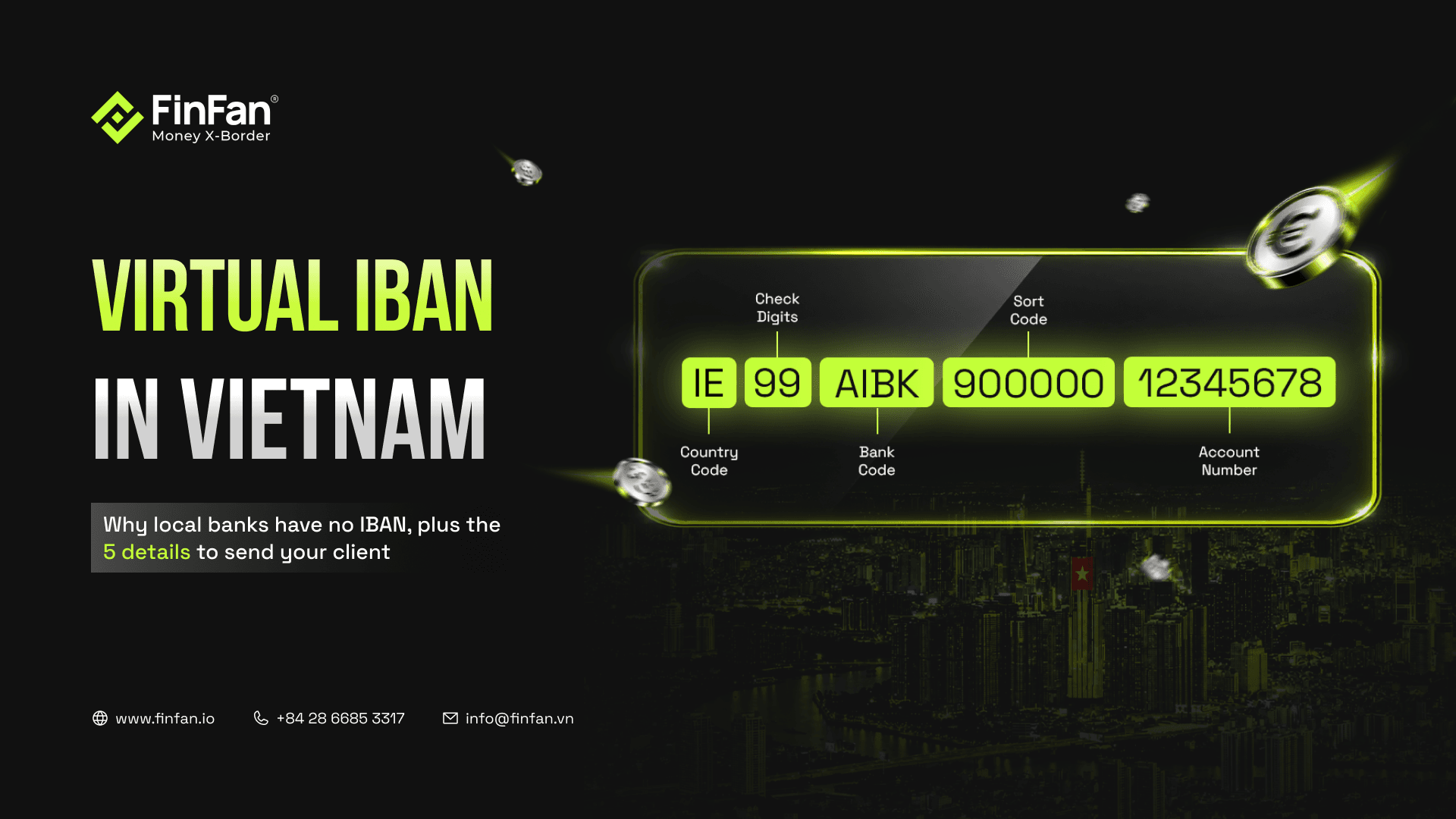
Searches for a virtual IBAN in Vietnam usually start with one request: a European client asks a freelancer or service exporter in Vietnam to “send your IBAN”. The short answer is that banks in Vietnam do not issue IBANs, so a standard Vietnamese bank account has no IBAN to share. You can still get paid from Europe. You need to know which details to send instead and what virtual IBANs and virtual accounts can and cannot do for you. This guide explains how IBANs work, how a virtual IBAN differs from a regular one, and what recipients in Vietnam should prepare before invoicing an international client.
What an IBAN Is?
IBAN stands for International Bank Account Number. It is a standard format that identifies a specific bank account in cross-border payments between countries that use the system. IBANs follow the ISO 13616 standard and contain up to 34 letters and digits.
The Structure of an IBAN
Each country sets its own IBAN length, but every IBAN has three parts in the same order:
- Country code: two letters, such as GB for the United Kingdom or DE for Germany.
- Check digits: two numbers that let systems catch input errors.
- Basic Bank Account Number (BBAN): the bank, branch, and account details in that country’s format.
A commonly cited example is the UK IBAN GB29NWBK60161331926819, which has 22 characters. GB is the country code, 29 are the check digits, and NWBK identifies the bank (NatWest).
Which Countries Use IBANs
According to a 2024 report by the European Banking Authority (EBA):
- around 60 jurisdictions mandate IBANs;
- more than 20 others recommend IBANs for cross-border payments.
IBANs are most common in Europe and the Middle East. Several major markets use their own account numbering instead, including the United States, Canada, Mexico, Australia, New Zealand, China, and Japan.
In Europe, IBANs are closely tied to SEPA (the Single Euro Payments Area), a euro payment zone of 36 countries. For a SEPA transfer, the IBAN is the only account detail the sender needs, and SEPA Instant transfers can arrive in under 10 seconds.
IBAN vs SWIFT/BIC vs Local Account Numbers
These codes are often confused, but each identifies something different.

SWIFT is the global interbank messaging network. The SWIFT/BIC code tells the payment which bank to go to. The IBAN, or account number, tells you which account at that bank. A payment to an IBAN country usually needs both.
Does Vietnam Use IBAN?
No. Banks in Vietnam do not issue IBANs for domestic accounts, including the largest banks. To receive money from abroad, a recipient in Vietnam uses the receiving bank’s SWIFT/BIC code together with a standard account number.
What to Send Your International Client
To receive an international transfer into a Vietnamese bank account, share:
- the recipient’s full name, exactly as it appears on the account;
- the recipient’s account number;
- the bank’s name in English;
- the bank’s address;
- the bank’s SWIFT/BIC code.
Check the SWIFT code on your bank’s official website or app. Some banks use different SWIFT codes for different branches, so confirm which one applies to your account.
When a European Client Insists on an IBAN
Many European clients are used to SEPA transfers, and their accounting systems ask for an IBAN by default. Because a Vietnamese account has no IBAN, the client must send an international SWIFT transfer instead of a SEPA transfer.
This has three practical consequences:
- The client pays higher international transfer fees than a SEPA transfer would cost;
- The payment may pass through intermediary banks that deduct fees before it reaches you
- The payment takes longer than a transfer within SEPA.
To avoid confusion, explain upfront that your Vietnamese account has no IBAN and share the full SWIFT details listed above. Agree in advance on who pays the transfer fees (OUR, SHA, or BEN). FinFan’s guide to international payment receiving fees in Vietnam covers these options in detail.
What a Virtual IBAN Is
When you research IBANs, you will come across “virtual IBANs” and “virtual accounts”. Many payment platforms use these to give recipients outside Europe, the UK, or the US account details in those markets.
How Regulators Define a Virtual IBAN
The EBA’s 2024 report found that there is no legal definition of a virtual IBAN at the EU level. The industry and national authorities do not yet share a common understanding of the term. The EU’s new Anti-Money Laundering Regulation (AMLR) introduced the first definition: a virtual IBAN is an identifier that causes payments to be redirected to a payment account identified by a different IBAN.
A key feature is that a virtual IBAN has the same format and function as a standard IBAN, so third parties cannot tell the two apart. The EBA also flagged risks, including money laundering risk, when the issuer does not know the identity of the virtual IBAN’s end user.
How a Virtual IBAN Works
A traditional IBAN is linked one-to-one to a physical bank account. A virtual IBAN routes funds to a central master account, potentially alongside thousands of other virtual IBANs. Each payer sees a normal IBAN. The provider uses the virtual IBAN to identify who the payment belongs to and to reconcile it automatically.

A Virtual Account Is Not Always a Virtual IBAN
A virtual account is a broader concept than a virtual IBAN. Every virtual IBAN is a virtual account, but not every virtual account functions as a virtual IBAN.
The format depends on the market where the account is issued:
- In the United States, virtual accounts typically come with an account number and an ABA routing number for ACH and Fedwire, with no IBAN.
- In IBAN countries, a virtual account may take the form of a virtual IBAN.
So when a provider advertises an “international account”, ask exactly what format it uses, which payment channels it accepts, and in which markets.
What to Check Before Using a Virtual Account or Virtual IBAN
Before sharing a virtual account number with a client, get clear answers to four questions:
- Whose name is the account in? An account in your own name builds client trust and simplifies reconciliation compared with a shared platform account.
- Who issues the account, and where is that party licensed? A provider should hold the relevant regulatory licenses. This tells you who is responsible for your funds at each step.
- How do funds reach Vietnam? Ask which bank converts the currency, how the exchange rate is shown, and how long it takes.
- What documentation comes with each payment? From 2026, clear proof of the source of funds is a practical requirement when individuals and household businesses in Vietnam file taxes.
FinFan’s Perspective on Receiving International Payments in Your Own Name
Freelancers and service exporters often ask FinFan how to “get an IBAN”. The real need behind the question is usually this: making it easy and affordable for overseas clients to pay, while the money still arrives in Vietnam with full documentation. IRID (Global Collection) was built for exactly that.
IRID Multi-Currency Virtual Accounts in Your Own Name
IRID is a technology platform that lets individuals and businesses in Vietnam open multi-currency virtual accounts in their own name. The accounts are issued on infrastructure from Visa and Currencycloud. In the FinFan portal, receiving account details are shown per currency and per payment method:
- ACH and Fedwire via Community Federal Savings Bank (United States);
- SWIFT via The Currency Cloud Limited (United Kingdom).
Clients in the US, UK, or EU can pay through their domestic payment networks instead of sending an international transfer. Each IRID customer has a unique IRID code used to identify and reconcile every incoming payment.
IRID supports up to 30+ currencies; currently available in the interface are EUR, USD, GBP, JPY, AUD, and CAD. Accounts are activated in 1–2 business days, with no fee to open or maintain them. Receiving fees vary by channel; see the fee schedule in FinFan’s guide to international payment receiving fees in Vietnam.
Funds Reach Vietnam Through a Partner Bank, With Documentation
When you withdraw to Vietnam, a partner bank in Vietnam handles the collection and currency conversion. The exchange rate is applied by the partner bank and shown before you confirm the transaction.
Each withdrawal requires a declared purpose, along with invoice or order details when the system asks for them. As a result, every payment that reaches you comes with documentation for reconciliation and tax filing.
Conclusion
An IBAN is the ISO 13616 standard for international bank account numbers, widely used in Europe and the Middle East. Banks in Vietnam do not issue IBANs.
When an overseas client needs to pay you, you have two options:
- Share full SWIFT details to receive funds directly into a Vietnamese bank account.
- Use a virtual account in your own name, so the client can pay through their domestic network.
Virtual IBANs are one form of virtual account. They look like standard IBANs, but route funds to a master account, and EU regulators are still defining how they should be treated. Whichever route you choose, understand the account format, the issuer, how funds reach Vietnam, and what documentation comes with each payment. These factors decide the cost and transparency of every payment you receive.
Are you a freelancer, an IT outsourcing company, or a service exporter who regularly receives payments from Europe, the UK, or the US? The FinFan team can walk you through opening an IRID multi-currency virtual account, the channels that suit your clients, and how withdrawals to Vietnam work.
- Website: https://finfan.io
- Email: support@finfan.vn
- Phone: +84 2866.853.317
Disclaimer
IRID is a technology platform developed by FinFan (Nhat Phuong Joint Stock Company - Best Way Corporation) that enables individuals and businesses in Vietnam to receive and manage international funds. IRID operates on the infrastructure of international financial partners. Multi-currency virtual accounts are issued in the customer's name. Collection and foreign currency conversion services are provided by partner banks in Vietnam. FinFan is not a bank and does not provide deposit services.
This article is provided for general information only and does not constitute legal, tax or investment advice. Interfaces, processes, fees and processing times may change; please refer to the current guide and fee schedule. Regulations may change; please refer to the current legal texts or consult a qualified adviser regarding your specific situation.
References
- European Banking Authority – Report on virtual IBANs (EBA/Rep/2024/08, 05/2024)
- European Banking Authority – Press release on virtual IBANs report
- PwC Legal – EBA findings on virtual IBANs
- FIAU Malta – EBA issues report on virtual IBANs
- Linklaters – EBA puts virtual IBANs into regulatory spotlight
- WorldFirst – What is an IBAN code
- Ria Money Transfer – IBAN: Find, check, or calculate IBAN
- TOPI – What is an IBAN code, distinguishing IBAN from BIC and SWIFT

Dr. Tuyen Nguyen
Money Beyond Borders