






Embedded Finance in Vietnam and One API for Every Payout Channel

Embedded finance in Vietnam has moved past the pilot stage and now sits on the roadmap of most platforms that serve Vietnamese users. A marketplace needs to pay its sellers. A software company needs to pay engineers in Hanoi. A money transfer operator needs funds to reach a recipient in Ca Mau within seconds. These are three different products with one shared obstacle: Vietnam has many ways to receive money, each with its own technical standard and its own regulatory file. This article explains the single-API payout model, how responsibility is divided between the parties, and what to verify before signing with a partner.
What embedded finance means in a cross-border payout context
Embedded finance describes a non-financial company delivering a financial service inside its own product. The user completes the transaction without leaving the app and without dealing with a separate provider. The company does not become a financial institution. It connects to a party that already holds the relevant license and infrastructure.
The three layers behind every embedded finance transaction
Every embedded finance transaction separates into three layers, and each layer carries a different type of responsibility. The interface layer is where the user acts: a ride-hailing app, a marketplace, an HR platform, or an international transfer app. This layer owns the customer relationship and defines the experience.
The orchestration layer receives the instruction, normalizes the data, routes the transaction to the correct processing channel, and returns status and reconciliation records. It holds no financial licence, but it determines integration speed and transaction success rates.
The licensed layer is where the financial act happens. A bank credits an account. An e-wallet issuer records a balance. A licensed institution performs the currency conversion. This layer answers to the regulator.
Teams that keep these three layers distinct ask better questions during partner selection. Who performs which step, who carries which obligation, and which party the contract actually binds.
Why payout is usually the first use case to go live
Among embedded finance use cases, cross-border payout tends to launch first. The reason is structural. Payout has a measurable output: success rate and time to completion. It depends far less on risk underwriting than lending or insurance, so the build is shorter and the failure modes are easier to monitor.
Vietnam reinforces that logic. Inbound flows into the country have stayed large and stable for years. Remittances into Vietnam are estimated at USD 16–18 billion a year, according to World Bank data, placing Vietnam among the largest recipient markets globally. Alongside that sits a growing commercial flow: marketplace seller payouts, salaries for remote staff, and commissions for affiliates.
The problems Vietnam creates for embedded finance teams
Volume is not the constraint. The constraint is channel structure, and the constraint is licensing.
A large inbound flow spread across fragmented channels
Recipients in Vietnam do not converge on one channel. Younger users in cities expect money in an e-wallet. Older recipients in the provinces still collect cash at a bank counter or a post office. Business owners want funds in a settlement account so working capital turns over the same day.
The market therefore runs four parallel channel groups: bank accounts, e-wallets, cash collection points, and ATMs. Each group then splits by provider. E-wallets alone include MoMo, ZaloPay, VNPay and ViettelMoney, with different protocols and different data formats.
Integration cost scales with the number of counterparties
A platform that wants full coverage signs a separate contract, runs a separate integration project, and operates a separate reconciliation process with each provider. The cost does not stop at building. Every counterparty adds a maintenance cycle, a reporting format, and an incident escalation path.
The common outcome is predictable. The platform integrates one or two channels to ship quickly, then discovers that a meaningful share of recipients does not use those channels. Failure rates climb, senders complain, and the platform returns to expand coverage at a higher cost than the original scope.
Licensing is an entry condition, not a later step
Receiving and paying out foreign currency in Vietnam is a conditional business activity under Vietnamese law.
Decree No. 89/2016/ND-CP dated 1 July 2016 sets the conditions for foreign exchange agency activities and for the provision of foreign currency receipt and payment services by economic organisations. It was amended and supplemented by Decree No. 23/2023/ND-CP dated 12 May 2023, effective from 1 July 2023. Under the decree, an economic organization seeking to directly receive and pay foreign currency must hold a contract with a foreign partner covering that service and must submit an implementation plan signed by its legal representative.
The operating detail sits in Circular No. 34/2015/TT-NHNN dated 31 December 2015 issued by the Governor of the State Bank of Vietnam, which has since been amended by Circular No. 11/2016/TT-NHNN dated 29 June 2016 and Circular No. 15/2019/TT-NHNN dated 11 October 2019.
The practical consequence is simple. An international platform cannot pay recipients in Vietnam on its own. It works through an organization approved by the State Bank of Vietnam or through a domestic commercial bank. Partner selection therefore matters more than technology selection.
How a single payout API works in Vietnam
The model places one orchestration layer between the international platform and the domestic payout channels. The platform integrates once, then reaches any channel through the same endpoints and the same data structure.
Four payout channels through one integration
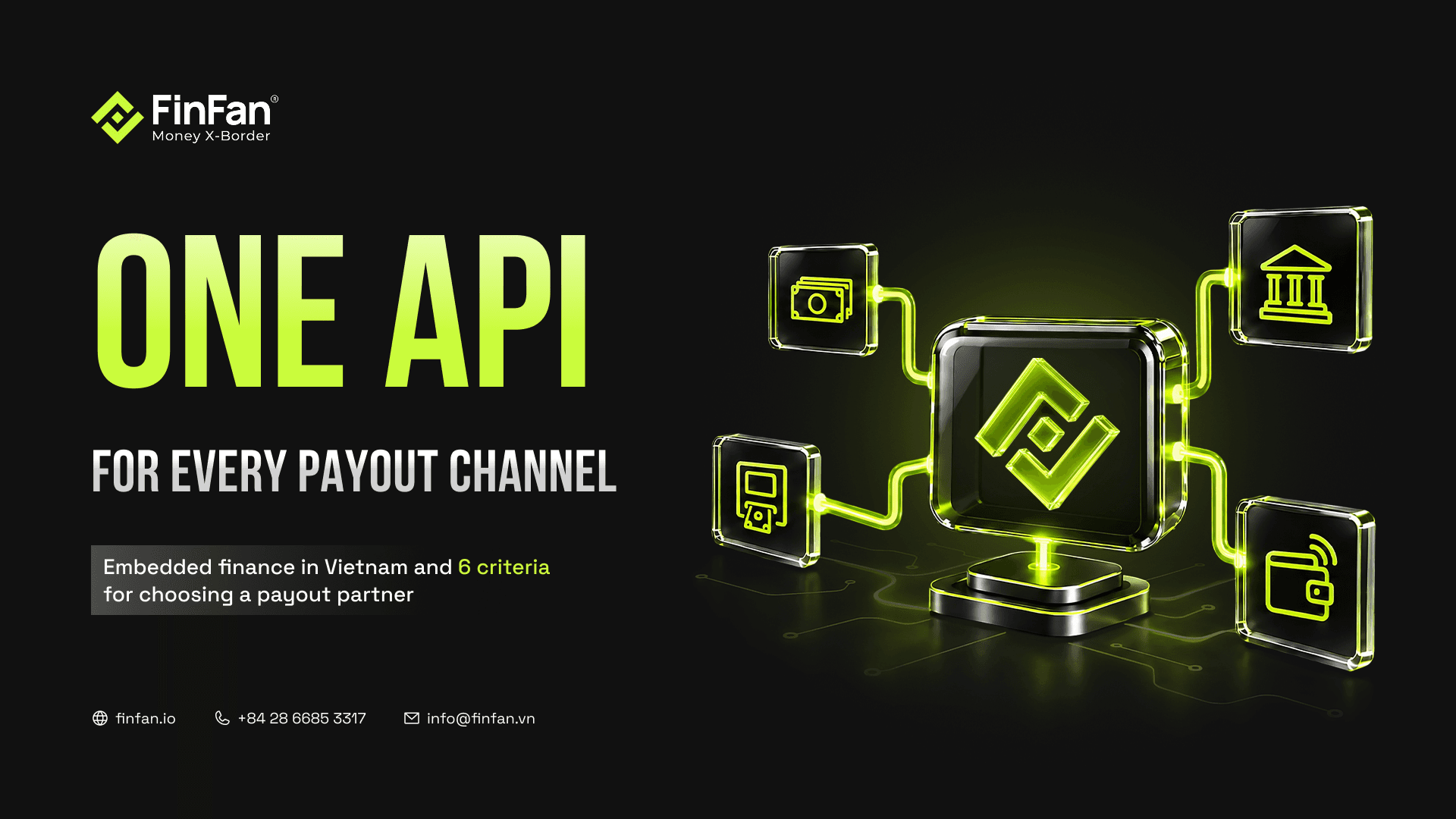
FinFan operates a single integration API connecting four payout channel groups in Vietnam:
- Bank accounts. Funds credited directly to the beneficiary's account in real time, 24/7, through the domestic partner bank network.
- E-wallets. Direct payout into MoMo, ZaloPay, VNPay, and ViettelMoney.
- Cash collection points. Cash is collected at bank counters or across the Vietnam Post network.
- ATMs. Withdrawal through the ATM network.
One integration reaches all four groups. On the sending side, the network covers more than 150 countries, with over 30 international money transfer operators connected, including MoneyGram, Thunes, and Remitly.
Who holds the license for which part of the flow
This section matters because it determines how liability is written into the contract.
FinFan is the commercial brand of Nhat Phuong Joint Stock Company (Best Way Corporation), licensed by the State Bank of Vietnam for foreign currency acceptance and payment under License No. 973/GP-HCM, most recently renewed under Decision No. 21/QD-HCM dated 10 January 2022. In the payout flow, FinFan receives instructions from the international partner, orchestrates the transaction, and routes it to the appropriate channel.
Crediting the beneficiary is performed by partner banks and e-wallet issuers under their own licenses. FinFan is not a bank and does not provide deposit services.
This split does not add steps for the international partner. It removes them. Instead of contracting and reconciling with each bank and each wallet, the partner works with one counterparty accountable for the whole orchestration.
Common use cases for the payout API
The API supports both single transactions and batch disbursement. Live use cases include:
- Remittance payout. An international money transfer operator submits the instruction; the recipient in Vietnam collects through their preferred channel.
- Cross-border payroll. A foreign employer pays staff based in Vietnam on a recurring cycle, processed in batches.
- Marketplace seller payouts. An international platform disburses revenue to Vietnamese sellers.
- Freelancer and affiliate payouts. Digital platforms settle high-volume, low-value transactions.
- Treasury operations. Businesses move funds between entities.
All of these run with full AML and KYC procedures under applicable regulations.
How to evaluate a payout partner in Vietnam
Before signing, ask a prospective partner to document the following six points.
- Legal basis. Which license or written approval the partner operates under, the reference number, and the validity period. Request a copy of the current approval rather than a general statement.
- Division of responsibility. Which steps the partner performs and which steps the bank or wallet issuer performs. The contract should reflect that division precisely.
- Actual channel coverage. The list of banks and wallets connected directly, kept separate from the list reached indirectly through a third party.
- Integration quality. API documentation, sandbox environment, webhook status notifications, versioning policy, and technical support hours.
- Reconciliation mechanics. Reconciliation frequency, report formats, handling of pending transactions, and the return timeline when a payout fails.
- Compliance posture. AML and KYC procedures, sanctions screening, and how the partner handles information requests from regulators.
Conclusion
Embedded finance in Vietnam is not primarily a technology problem. The real friction comes from a market with many parallel receiving channels and from a legal framework that treats foreign currency receipt and payment as a conditional activity. A platform that tries to handle all of it alone pays in integration time, operating overhead, and compliance exposure.
The single-API payout model reduces that to one integration and one accountable counterparty. What deserves scrutiny is not the feature list. It is the partner's license, the division of responsibility between the parties, and the quality of reconciliation. Those three factors decide whether the partnership holds up after launch.
FinFan is the Vietnam payout partner for more than 30 international money transfer operators, operating under License No. 973/GP-HCM issued by the State Bank of Vietnam for foreign currency acceptance and payment. If your team is building a payout flow into Vietnam, we can walk through channel coverage, integration steps, and compliance requirements.
- Website: https://finfan.io
- Email: info@finfan.vn
- Điện thoại: +84 2866.853.317
Disclaimer
FinFan is not a bank and does not provide deposit services. FinFan receives and orchestrates payout instructions; crediting beneficiaries is carried out by partner banks and e-wallet issuers in Vietnam under their own licenses. This article is general information and does not constitute legal or financial advice.
References
- Consolidated Document No. 15/VBHN-NHNN dated 22 June 2023, consolidating Decree No. 89/2016/ND-CP as amended and supplemented by Decree No. 23/2023/ND-CP (issued 12 May 2023, effective 1 July 2023)
- Circular No. 34/2015/TT-NHNN dated 31 December 2015 guiding the provision of foreign currency receipt and payment services, as amended and supplemented by Circular No. 11/2016/TT-NHNN dated 29 June 2016
- Consolidated Document No. 24/VBHN-NHNN dated 20 January 2026, consolidating the Circular guiding the provision of foreign currency receipt and payment services
- Circular No. 15/2019/TT-NHNN dated 11 October 2019 amending legal documents on administrative procedures in foreign exchange management, as partially amended or repealed by Circular No. 24/2022/TT-NHNN, Circular No. 75/2025/TT-NHNN and Circular No. 78/2025/TT-NHNN

Dr. Tuyen Nguyen
Money Beyond Borders