






Cross-Border Payment API and How to Integrate Once in Vietnam

A cross-border payment API determines most of the operating cost of an international platform expanding into Vietnam, but that cost usually only becomes visible after the product has been live for a few months. The initial build always looks simple: call an endpoint, pass the recipient details, wait for the response. The problems appear at the first reconciliation, the first stuck transaction, and the first request from the business team to add another payout channel. This article walks through the lifecycle of a payout transaction via API, the technical requirements that determine integration quality, and the roadmap for getting a payout flow into Vietnam running reliably.
Why integrating channel by channel costs more than it looks
Vietnam has four parallel channel groups for receiving funds: bank accounts, e-wallets, cash collection points, and ATMs. Each group then splits by provider. E-wallets alone include MoMo, ZaloPay, VNPay, and ViettelMoney.
Development effort is not the expensive part
Integrating directly with one bank typically takes somewhere between a few weeks and a few months. That number is easy to estimate and easy to put in a plan. The harder number comes afterwards.
Every integration adds its own maintenance cycle. When a counterparty ships a new version, your team retests. When a transaction fails, your operations team needs to know who to contact, through which channel, and during which hours. When finance closes the month, each counterparty sends a different report format.
Multiply those by the number of counterparties, and total operating cost grows far faster than total development cost.
Each channel brings its own data model and status set
The deeper difference sits in the data model. A bank payout needs an account number and a bank code. An e-wallet payout needs a registered phone number. A cash collection needs identity document details and a collection reference.
Status sets diverge too. One channel returns a final state within seconds. Another holds the transaction in a pending state until the recipient visits a counter, which can take days. A platform handling this alone has to build a status mapping layer per channel and maintain that layer indefinitely.
How a single cross-border payment API works
The single-API model moves that mapping work into one orchestration layer.
One orchestration layer between your platform and domestic channels
Your platform integrates once, against one set of endpoints, one data structure, and one unified status set. The orchestration layer receives the instruction, reshapes the data to meet each channel's requirements, routes the transaction, tracks its state, and returns results in a consistent format.
FinFan operates a single integration API on this model, connecting four payout channel groups in Vietnam through one integration. On the sending side, the network covers more than 150 countries, with over 30 international money transfer operators connected, including MoneyGram, Thunes, and Remitly.
The lifecycle of a payout transaction
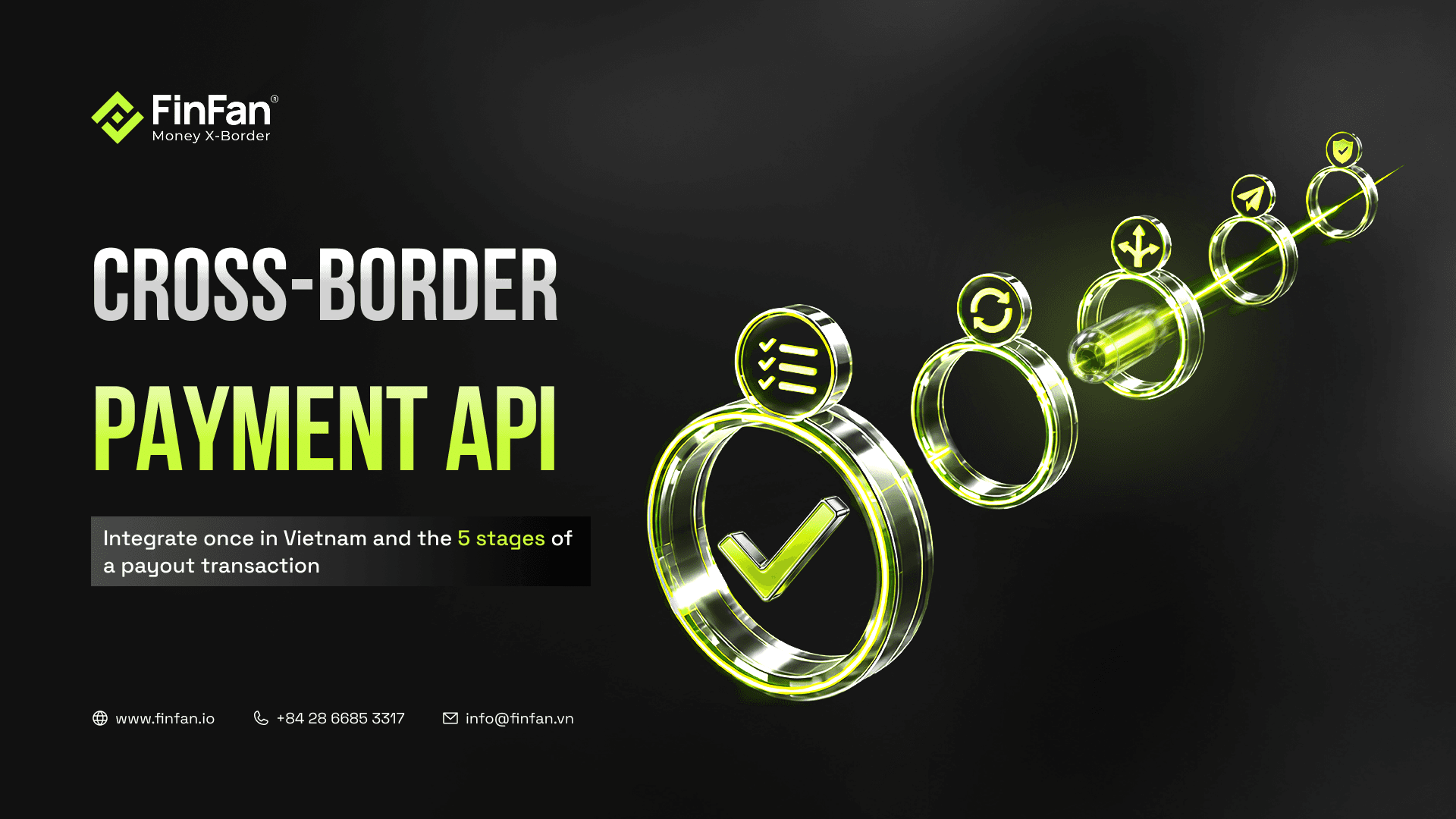
A payout transaction generally moves through five stages.
- Stage one, pre-submission validation. Your platform checks the recipient details against the destination channel. This catches a wrong account number or an unregistered wallet phone number before funds move, which lowers the downstream failure rate.
- Stage two, submission. You send sender details, recipient details, amount, currency, payout channel, and transaction purpose. Each instruction carries a unique reference generated on your side.
- Stage three, acceptance and routing. The orchestration layer acknowledges receipt, runs compliance checks, then routes the transaction to the appropriate channel.
- Stage four, status progression. The transaction passes through intermediate states before reaching a terminal state. There are three terminal outcomes: completed, failed, or returned to the sender.
- Stage five, reconciliation. At the close of each cycle, both sides match transaction lists and amounts. This catches discrepancies the real-time flow missed.
Single transactions and batch disbursement
These two flows serve different business cases and should be designed differently.
Single transactions suit remittance payout, where each instruction originates independently from sender behavior. The primary requirement is response time.
Batch disbursement suits payroll, marketplace seller payouts, freelancer and affiliate payouts, and treasury operations. Here the primary requirement is not speed but partial processing: when a batch holds ten thousand instructions and thirty fail, those thirty must be retryable without touching the rest.
Technical requirements that determine integration quality
Treat this section as an evaluation checklist when comparing providers.
Idempotency on retries
Networks fail mid-request. Your platform sends an instruction, receives no response, and cannot tell whether the instruction was accepted. If a retry creates a second transaction, the recipient is paid twice.
A payout API needs idempotency based on a reference your platform generates. When it receives an instruction carrying an existing reference, it returns the state of the original transaction instead of creating a new one. This is a requirement, not an optional feature.
Webhooks and status updates
There are two ways to learn that a transaction changed state: poll on a schedule or receive a push notification through a webhook. The second is far more efficient, but only under three conditions.
Webhooks need signature verification, so your platform can confirm the notification came from the expected source. They need a retry mechanism for when your receiving endpoint is down. And you still need a status query endpoint available for reconciliation when you suspect a notification was lost.
Failure handling and returns
Payouts fail for several reasons: incorrect recipient details, a frozen account, or a recipient who does not collect within the permitted window.
What the contract needs to specify is the return timeline for each case and how a returned state is represented in the data. Your platform needs this to answer sender inquiries, and it needs it as structured error codes rather than free-text descriptions.
Reconciliation data
A usable reconciliation report needs three properties: a stable format that does not drift between cycles, references that match your own transaction records, and a fee field kept separate from the principal amount.
Miss any one of the three, and your finance team handles the gap manually every cycle. This is the single largest hidden cost in a payout integration.
Compliance requirements built into the API flow
Compliance does not sit outside the technical flow. It sits inside the data structure of every instruction.
The legal basis in Vietnam
Receiving and paying out foreign currency in Vietnam is a conditional business activity. The conditions for economic organisations providing foreign currency receipt and payment services are set out in Consolidated Document No. 15/VBHN-NHNN dated 22 June 2023, which consolidates Decree No. 89/2016/ND-CP dated 1 July 2016, Decree No. 16/2019/ND-CP dated 1 February 2019 and Decree No. 23/2023/ND-CP dated 12 May 2023. Guidance on the provision of foreign currency receipt and payment services follows Consolidated Document No. 24/VBHN-NHNN dated 20 January 2026, which consolidates Circular No. 34/2015/TT-NHNN dated 31 December 2015 and its amending documents, namely Circular No. 11/2016/TT-NHNN, Circular No. 15/2019/TT-NHNN, Circular No. 24/2022/TT-NHNN and Circular No. 75/2025/TT-NHNN.
The consequence for an international platform is direct: you cannot pay recipients in Vietnam on your own. You work through an organisation approved by the State Bank of Vietnam, or through a domestic commercial bank.
FinFan operates under License No. 973/GP-HCM for foreign currency acceptance and payment, issued by the State Bank of Vietnam and most recently renewed under Decision No. 21/QD-HCM dated 10 January 2022.
AML and KYC data in the payout flow
Every payout instruction needs to carry enough information for compliance screening: sender identity, recipient identity, transaction purpose, and source of funds. Payout operations through FinFan's API run with full AML and KYC procedures under applicable regulations.
For an engineering team, this means compliance fields must be captured at the top of the funnel, in your own product, rather than appended later. A design that omits them at the start forces a user interface rework once the flow is already live.
A realistic integration path with FinFan
Integration projects usually move through five phases.
- Phase one, scope definition. Agree on the payout channels to cover, the business cases involved, expected transaction volume, and settlement time requirements.
- Phase two, documentation and contracting. Both sides exchange corporate and compliance documentation and sign the service agreement.
- Phase three, sandbox development. Your team integrates against the API documentation and tests the success, failure, duplicate, and return scenarios.
- Phase four, controlled launch. Go live at low volume on one channel, monitor the success rate, and review the first reconciliation report in full.
- Phase five, expansion. Add channels and raise volume based on observed results.
Phase four is the phase most often compressed, and the phase that surfaces the most issues. Run a complete reconciliation cycle before scaling volume.
Conclusion
A cross-border payment API is not a single endpoint that moves money. It is a system that has to handle duplicate submissions, states that stay open for days, failures that require returns, and reconciliation data that matches the books on both sides.
Vietnam multiplies that work because four parallel channel groups carry different data models and different status sets. The single-API model compresses it into one integration and one accountable counterparty. When evaluating a provider, the three questions worth asking first are how idempotency is handled, how webhooks are secured and retried, and what the reconciliation report looks like. Those three answers predict your operating cost for the years that follow fairly accurately.
FinFan is the Vietnam payout partner for more than 30 international money transfer operators, operating under License No. 973/GP-HCM for foreign currency acceptance and payment. If your team is planning a payout integration into Vietnam, we can walk through channel coverage, API documentation, and compliance requirements.
- Website: https://finfan.io
- Email: info@finfan.vn
- Phone: +84 28 6685 3317
Disclaimer
FinFan is not a bank and does not provide deposit services. FinFan receives and orchestrates payout instructions; crediting beneficiaries is carried out by partner banks and e-wallet issuers in Vietnam under their own licenses. This article is general information and does not constitute legal or technical advice for any specific case.
References

Dr. Tuyen Nguyen
Money Beyond Borders