






Cross-Border QR Payment in Vietnam for Merchants Serving International Visitors

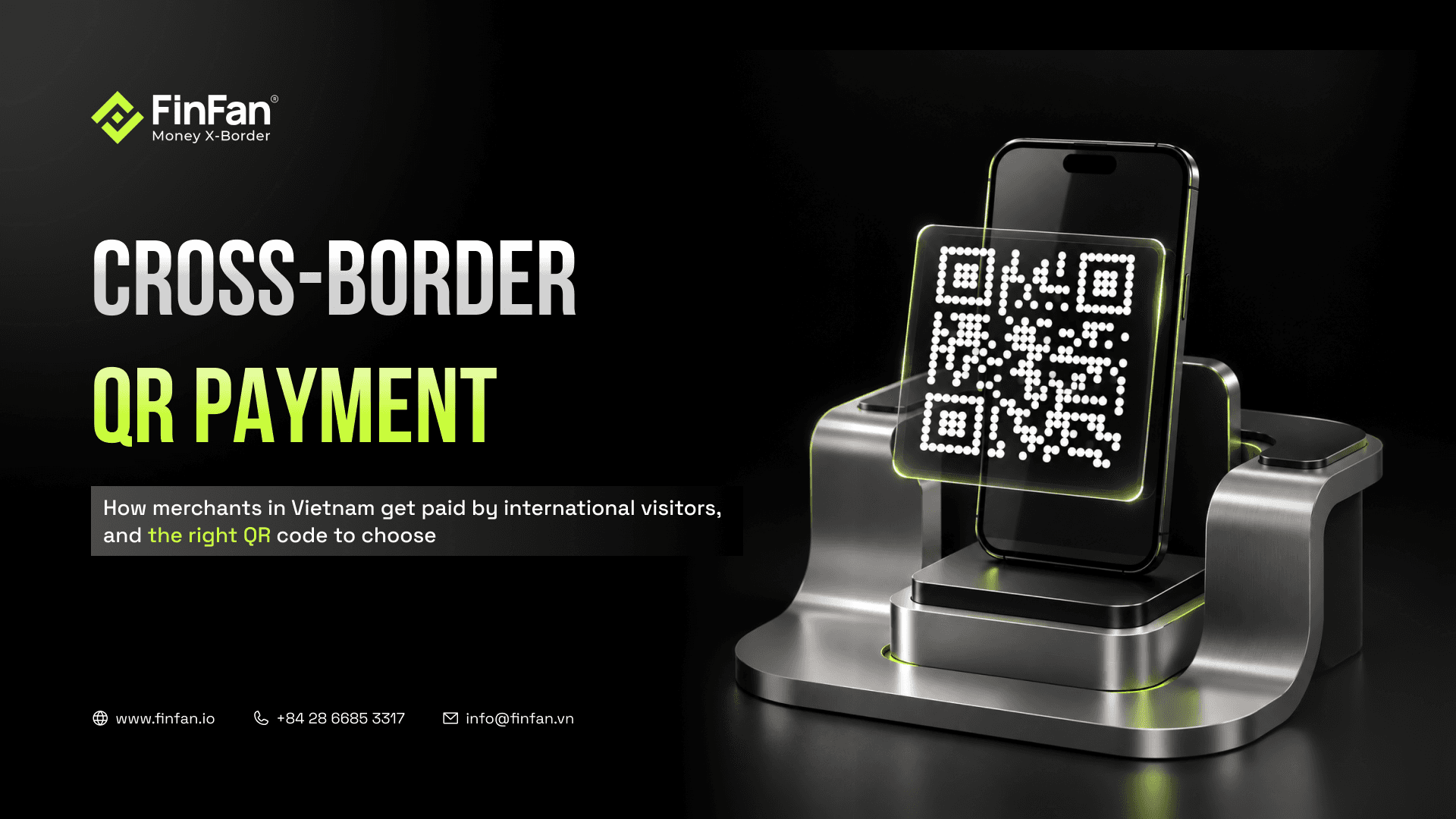
Cross-border QR payment lets a foreign visitor open the banking app or e-wallet they use at home, scan a code at your counter, and pay on the spot. For merchants in Vietnam, this solves a familiar scene: a tourist wants to buy something, has no Vietnamese cash, their card gets declined, and the sale ends there. The infrastructure already operates here, connected to several markets, with acceptance costs well below international cards. This article explains how the mechanism works, what merchants gain, and, most importantly, the one distinction you need to understand to set it up in compliance with regulations.
What cross-border QR payment means
Cross-border QR payment allows a customer from one country to pay a merchant in another by scanning a QR code, using the same banking app or e-wallet they already use every day.
All the complexity sits behind the scenes. The national payment switches of both countries connect to each other, handling code recognition, currency conversion and fund transfer. The customer sees one familiar action. The merchant sees funds arriving in VND.
What happens at the counter
A Chinese tourist walks into a café in Da Nang. They open their Korean banking app, scan the QR code on the counter, enter the amount and confirm. The app displays the converted amount in won at the exchange rate applied at that moment. The transaction completes in seconds and both sides receive confirmation.
The café owner does nothing beyond checking the notification. The amount is recorded in VND, so the merchant carries no exchange rate risk.
How this differs from accepting international cards
International cards travel through card networks, with several parties involved in processing. Each takes a share, and the merchant absorbs the total as a merchant discount rate (MDR).
Cross-border QR payment travels through the domestic payment switches of both countries, with fewer intermediaries. The fee structure is simpler as a result, and usually lower.
There is a second difference worth knowing: approval rates. A card issued overseas and swiped in Vietnam can be declined for several reasons, including the issuing bank's fraud controls, international transaction limits, or simply because the traveler never enabled overseas payments. A QR payment runs through an app the customer is already logged into, so it meets fewer of these barriers.
Why merchants in Vietnam lose revenue from international customers
Vietnam receives a large and growing number of international visitors, but the ability to collect from them has not kept pace.
Heavy reliance on cash
Many small shops, eateries, and tourist spots still mainly accept cash from foreign customers. The visitor has to find a currency exchange, carry cash around, and usually ends up with leftover small notes when they fly home. Every step in that chain is a point where the customer can walk away.
Upfront and per-transaction costs of card acceptance
Installing a POS terminal requires upfront investment and a bank contract. For a small shop, that figure is large enough to delay the decision. Once installed, the discount rate on every international card transaction continues to cut into margin. In sectors with small ticket sizes, such as food and beverage or souvenir retail, that percentage carries real weight.
Difficulty reconciling and declaring revenue
When a merchant takes foreign cash or receives money through informal channels, there is no clear transaction record. Come filing season, proving revenue becomes difficult. This matters more each year as tax authorities tighten oversight of household and individual businesses.
The cross-border QR payment infrastructure in Vietnam
The foundation for this service is the system operated by the National Payment Corporation of Vietnam (NAPAS).
VietQR Global and VietQRPay
NAPAS runs two QR payment services: VietQRPay for domestic payments and VietQR Global for cross-border payments. International visitors use their home banking app to scan a VietQR Global code and pay at acceptance points within the NAPAS member network nationwide, including retail stores, restaurants, hotels and tourist destinations.
Markets already connected
By mid-2026, VietQR Global had connected with Thailand, Laos, Cambodia and China, then expanded further. In July 2026, cross-border QR payment between Vietnam and Singapore launched on the basis of infrastructure connectivity between NAPAS and Liquid Group, making Singapore the sixth country and the fourth ASEAN market in the network.
China has multiple platforms connected. From April 2026, Chinese visitors could use the Alipay wallet to scan VietQR Global codes and pay in Vietnam. In August 2026, NAPAS, BIDV and Weixin Pay announced an expansion of the service, making Weixin Pay the third Chinese payment platform to complete a cross-border QR connection with NAPAS.
NAPAS has stated it will keep adding markets, working toward an interoperable regional QR payment network.
The reverse direction is still being built
Today the common direction is international visitors paying in Vietnam. The reverse, where Vietnamese users pay abroad with their domestic apps, is being rolled out by NAPAS with selected markets.
For merchants, the point to understand is that the service you join handles the inbound direction: collecting from foreign customers who are physically in Vietnam.
What merchants gain
Lower acceptance cost than cards
This is the clearest reason. Acceptance fees for cross-border QR payment generally sit meaningfully below the fees charged for accepting traditional international cards.
The exact rate depends on the bank, your business category and your specific contract. Ask for the fee schedule in writing before you sign, and ask explicitly whether any charges apply beyond the discount rate.
Fast setup with no equipment to buy
The simplest approach is printing a static QR code and placing it on the counter. Merchants who already run point-of-sale software can use a dynamic QR code generated per order, so the customer does not have to type the amount, and errors drop.
Neither approach requires a dedicated POS terminal or specialized network infrastructure.
Transaction data for reconciliation and tax filing
Every transaction through an official channel leaves a record: amount, timestamp, status. Merchants can review history, match it against sales, and export data for their accountant.
This is the significant difference from receiving money through channels with no contract behind them. Clear data lets you handle tax declarations proactively instead of reconstructing records later.
A wider customer base without extra marketing spend
When your shop displays a QR code that a visitor recognizes from their own app, the psychological barrier drops. Customers spend more freely when they are not rationing the cash left in their wallet.
What international customers gain
Understanding the customer side helps you explain it when they ask.
Customers pay through a familiar app with no new steps to learn. The system converts currency automatically and shows the rate on screen before they confirm. They do not need to carry large amounts of cash, which reduces the risk of loss. And the transaction completes quickly, so nobody waits at the counter.
The distinction between payment QR and personal transfer QR
This section is important, and it is the one most often skipped. It determines whether your setup is correct.
Two completely different types of code
A personal transfer QR code is tied to a personal bank account and used to receive transfers. Any merchant with a bank account can generate one, with no registration and no contract.
A payment acceptance QR code is tied to a contract between the merchant and a bank or acquiring party. The merchant has to register, submit business information and be approved.
Why the difference matters
A personal transfer QR code is faster to set up, but it carries one serious limitation: the system cannot distinguish a civil transaction from a payment for goods and services. Money a friend sends to settle a debt and money a customer pays for a meal sit side by side in the same statement line.
When you need to prove business revenue, you have no basis to separate them. With regulations on electronic invoicing and tax management for household businesses tightening, this is a real exposure.
A payment acceptance QR code, by contrast, produces a clear transaction record that supports sales management, financial management and transparent tax declaration. In exchange, the merchant follows the bank's registration and management process, signs a service agreement, and pays for use of the platform.
For business activity, the payment acceptance QR code is the correct choice.
Requirements and the process for merchants
Documents to prepare
Merchants need documents evidencing lawful business operation, the bank account details for receiving funds, and information on the legal representative. Household businesses and registered companies face different requirements, so ask for the full checklist before submitting.
Steps to go live
- Register with the bank or merchant development partner and submit your documents
- Sign the acceptance agreement and confirm the fee schedule
- Receive a static QR code, or integrate a dynamic code into your sales software
- Place the code at the counter or display it on the payment screen
- Monitor transactions and reconcile through the portal provided
Train your counter staff
The step most often overlooked. Staff needs to know how to guide a customer through scanning, how to recognize a successful confirmation screen, and what to do when a transaction fails. One short briefing prevents most of the awkward moments that happen in front of a customer.
FinFan’s Role in Cross-Border QR Payments
FinFan participates in this chain as a technology platform and merchant development partner.
Specifically, FinFan provides the platform connecting international payment providers with domestic banks, and develops the merchant acceptance network on behalf of partner banks. For the VietQR Global channel, FinFan acts as an agent of NAPAS, developing merchants and providing a portal where merchants track their transactions.
The division of roles should be stated plainly: merchants sign the payment acceptance agreement with a bank, not with FinFan. Banks in Vietnam handle payment acceptance and foreign currency conversion. NAPAS provides the VietQR Global solution.
FinFan also operates IRID, an international collection platform serving a different situation: clients abroad paying for goods or services you supply across a border. The two products address separate needs and do not substitute for each other.
Conclusion
Cross-border QR payment solves a specific problem for merchants in Vietnam: international customers who want to buy but have no workable way to pay. The infrastructure exists, the major source markets are connected, and setup costs far less than installing a card terminal.
The biggest benefit, though, is not the fee. It is that every transaction through an official channel leaves a clear record, letting you manage revenue and meet tax obligations on your own terms. A personal transfer QR code cannot give you that.
If you are considering it, start by identifying the correct type of QR code for your business, requesting the fee schedule in writing, and confirming which markets are currently connected. Those three steps determine most of the return on this investment.
Does your business serve international visitors and need a more convenient way to get paid at a reasonable cost? Talk to the FinFan team about a cross-border QR payment setup that fits your business model.
- Website: https://finfan.io
- Email: support@finfan.vn
- Phone: +84 2866.853.317
Disclaimer
FinFan (Nhat Phuong Joint Stock Company — Best Way Corporation) provides a connecting technology platform and develops the merchant acceptance network. Payment acceptance and foreign currency conversion services are carried out by partner banks in Vietnam. The VietQR Global solution is provided by the National Payment Corporation of Vietnam (NAPAS). FinFan is not a bank and does not provide deposit services.
This article is provided for general information only and does not constitute legal, tax or investment advice. Fees, the list of connected markets and participation requirements may change; please confirm current details with your bank or service provider. Regulations may change; please consult a qualified adviser regarding your specific situation.
References

Dr. Tuyen Nguyen
Money Beyond Borders