






The Stablecoin Sandwich: The "Hidden Infrastructure Layer" Redefining Cross-Border Payments

When Global Cash Flows Are Still "Stuck" in the Legacy System
For decades, cross-border payments have operated based on the correspondent banking system—a complex, fragmented architecture that relies on multiple intermediary layers. Although ensuring compliance and security, this model creates structural limitations: high costs, processing times lasting several days, and a lack of transparency in the reconciliation process.
In the context of a digital economy developing at an almost instantaneous pace, the fact that cash flows still take 3–5 days to complete a transaction becomes a major "bottleneck". Businesses not only bear significant intermediary costs but also face exchange rate risks during the waiting period. It is from this need for optimization that a new financial architecture has emerged: The Stablecoin Sandwich.
What is the Stablecoin Sandwich?

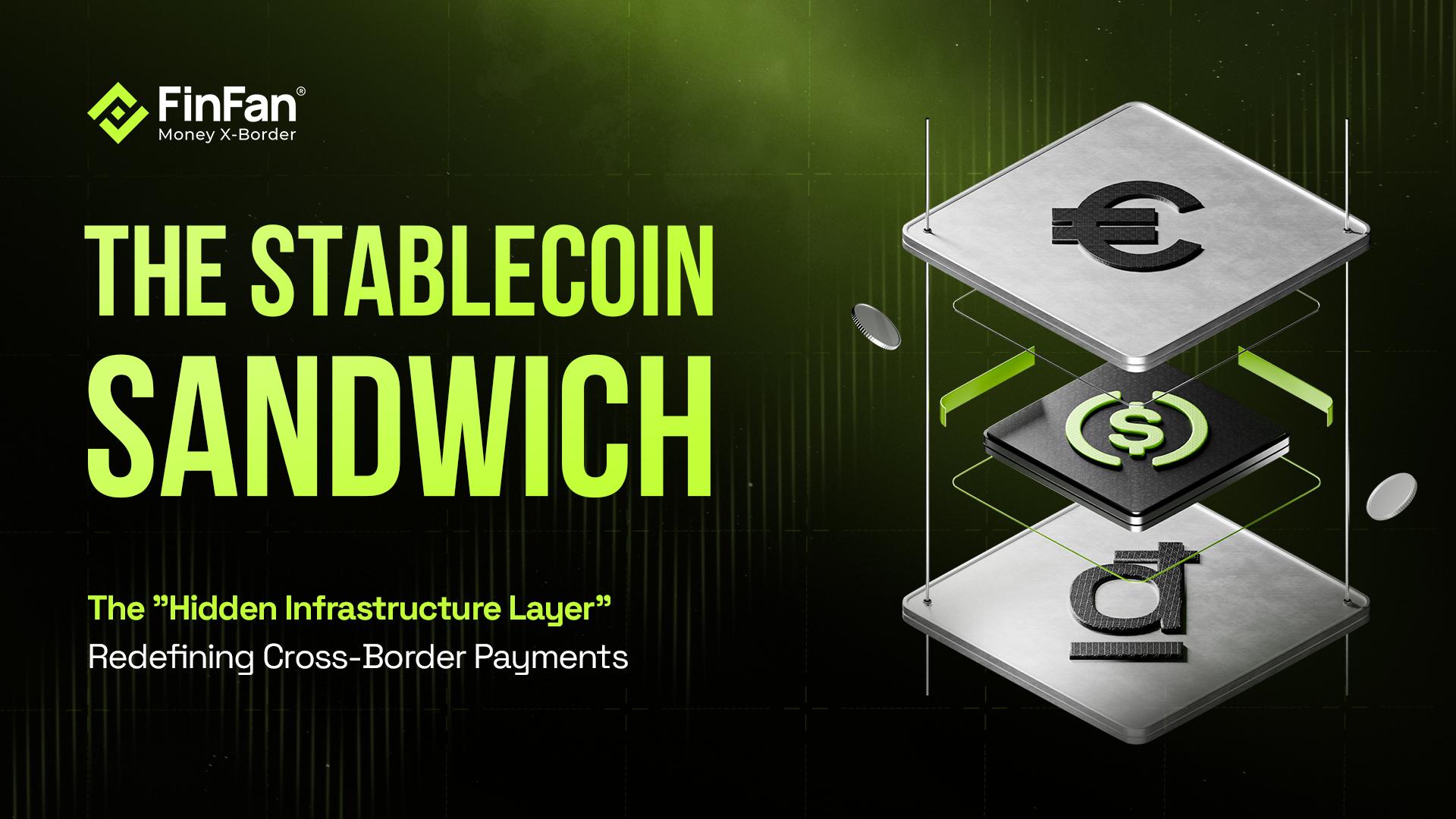
The Stablecoin Sandwich model represents a step forward in international payment infrastructure, where capital flows are operated through a tight three-layer structure:
- Initial layer: Fiat currency in the sending country.
- Intermediary layer: Stablecoins act as the transmission medium on the blockchain.
- Final layer: Fiat currency in the receiving country.
In essence, this process begins with converting money into stablecoins (on-ramp), executing instant cross-border transactions via a decentralized ledger, and ends with converting it back into local currency (off-ramp) for the beneficiary.
The core value of this architecture is decoupling the transfer of value from the slow traditional correspondent banking network. Stablecoins become a global payment "highway" with the advantages of transparency, high speed, and non-stop continuous operation capabilities. This solution optimizes the experience for entities such as MTOs, PSPs, or merchants as they can still transact in familiar fiat currencies without the need to directly manage or hold crypto assets.
Why is the Stablecoin Sandwich Model Attracting Attention?
The Stablecoin Sandwich marks a significant leap in operational efficiency compared to traditional methods through four core values:
- Optimizing speed: Instead of a multi-day process, transactions are now executed almost instantaneously, taking only a few seconds to a few minutes. This is a key factor for digital business models and e-commerce that require continuous cross-border cash flows.
- Cost reduction: By eliminating most intermediaries, the cost structure is focused solely on conversion fees at both ends and blockchain network fees, which are inherently low and transparent.
- Controlling exchange rate risks: The ability to settle instantly combined with pegging stablecoin prices to fiat currency helps businesses avoid negative impacts from FX fluctuations during the waiting time.
- Enhancing capital efficiency: Unlike the legacy system that requires maintaining pre-funded balances in multiple countries, the Stablecoin Sandwich allows capital flows to circulate flexibly, freeing up "frozen" financial resources.
This architecture is not merely a payment solution but also reshapes treasury management towards a flexible, real-time, and programmable direction.
Practical Applications and Infrastructure Development
The Stablecoin Sandwich model has now moved far beyond theoretical hypotheses to become infrastructure solutions practically operated through various specific use cases:
B2B Payments: Particularly useful in emerging markets as it helps optimize exchange rates and shortens payment schedules from weeks down to the same day. Gig Economy: Supports platforms in paying income to the global freelancer workforce rapidly within minutes instead of having to wait for days. Digital Commerce: Enables sectors such as SaaS, gaming, and digital content creation to execute seamless cross-border transactions without relying on the traditional banking system anymore.
Simultaneously, the completion of international legal frameworks such as MiCA in Europe, new acts in the US, along with clear regulations in Singapore and Hong Kong is creating a solid foundation for stablecoins. In Vietnam specifically, payment policy orientations and digital technology are opening up opportunities for the "hybrid rail" model—the intersection of blockchain and traditional finance. This is an important premise for Fintech entities to implement cross-border payment solutions using stablecoins transparently and in compliance with the law.
Correctly Identifying the Accompanying Risks
Despite possessing immense potential, the Stablecoin Sandwich model still has certain challenges rather than being an absolutely perfect solution.
Technically on the blockchain, large-scale transactions frequently face risks from MEV (Maximal Extractable Value), typically "sandwich attacks" on decentralized exchanges (DEXs). The consequence is slippage and degraded transaction performance if lacking specialized protection solutions. Concurrently, the "open sandwich" model—where stablecoin assets are held directly on-chain—also generates complex barriers in controlling compliance (KYC, AML) and transparentizing the origin of cash flows.
On a macroeconomic level, the strong rise of stablecoins is creating pressure on the existing financial system, especially concerning issues related to monetary sovereignty and the overall stability of the global financial market. Nevertheless, thanks to the combination of new technological advancements (MEV protection, intent-based DEX) and the clear shaping of legal frameworks, these risks are gradually being effectively controlled and overcome.
The Future of the Stablecoin Sandwich Model
Based on market data, stablecoins are entering an explosive growth cycle, with market capitalization projected to reach trillions of USD in the coming years. This trend is attracting strong participation from traditional financial institutions. Major entities from the banking system, payment card networks, to the SWIFT platform are actively testing or embedding structures similar to the Stablecoin Sandwich into their operational systems.
In addition, the user experience factor will be optimized towards being "invisible". Complex technical terms like blockchain, gas fees, or smart contracts will gradually be hidden, bringing a smooth and user-friendly transaction experience similar to traditional banking operations. In the not-too-distant future, the international money transfer process promises to become as simple as sending an email: fast, transparent, and happening almost instantly.
Conclusion
The Stablecoin Sandwich is not simply a new payment solution but is the symbol of financial infrastructure architecture in the next era. The intersection between the stability of fiat currency and the programmability and speed of the blockchain has helped this model completely resolve classic barriers in international payments, from optimizing costs and accelerating processing to enhancing the efficiency of capital utilization.
In that context, mastering and applying the Stablecoin Sandwich is no longer a backup plan but has become a key factor creating a sustainable competitive advantage for merchants, PSPs, MTOs, as well as any enterprise operating on a global scale.
Disclaimer: FinFan provides this content for educational purposes only; it is not financial or legal advice. FinFan is not liable for losses resulting from reliance on this information. Readers should conduct their own research (DYOR) and consult professionals.
Arthur.

Dr. Tuyen Nguyen
Money Beyond Borders