






Davos 2026: From Speculation to Infrastructure in Digital Finance

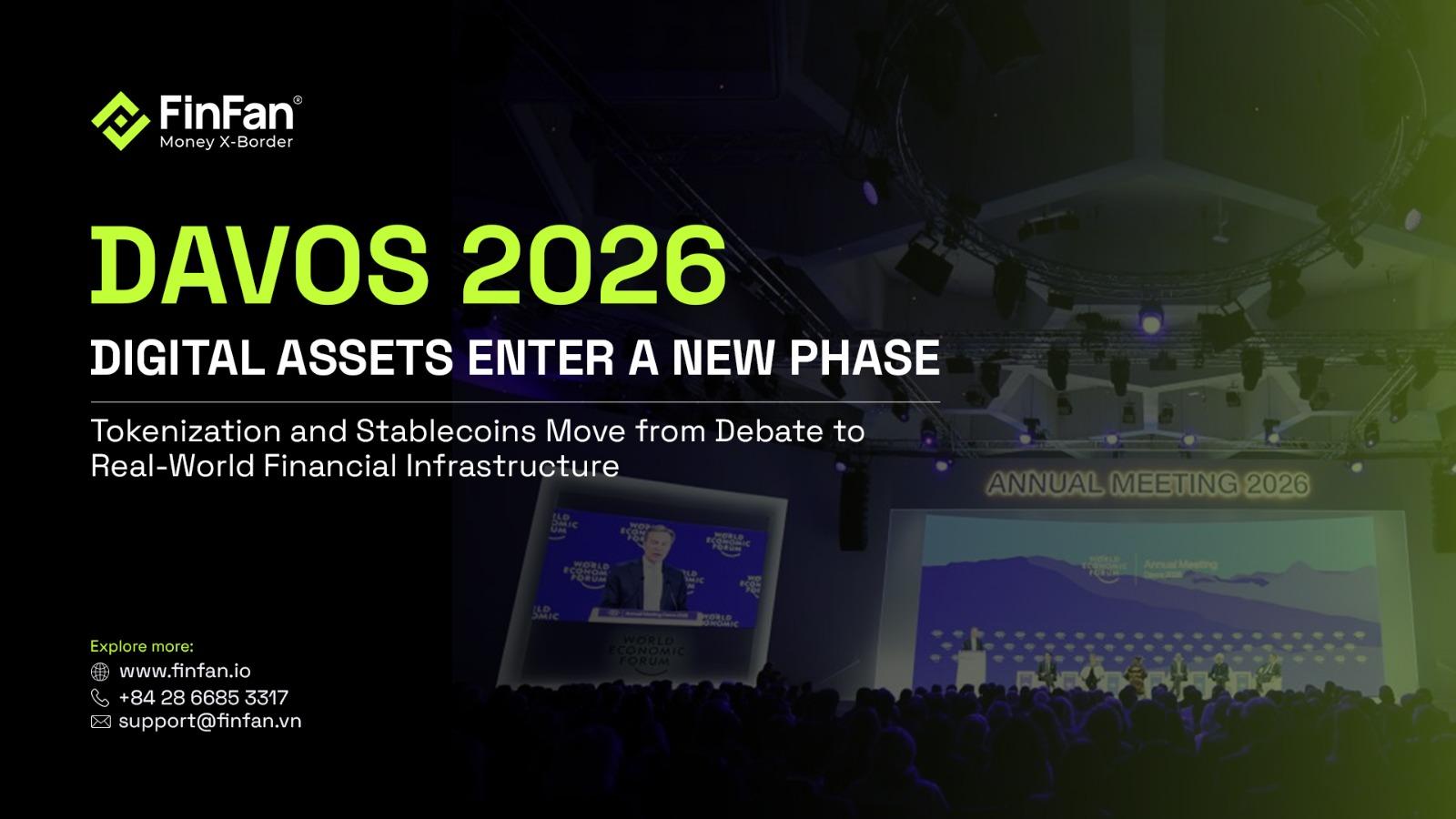
The 56th World Economic Forum Annual Meeting, also known as Davos 2026, took place in Davos, Switzerland, from January 19 to January 23, 2026. The event brings together government leaders, global financial institutions, technology companies, and policymakers to discuss the major trends shaping the future of the world economy, among which digital assets, tokenization, and stablecoins have emerged as key focal points this year.
For many years, crypto and digital assets were largely viewed through the lens of speculation or regulatory uncertainty. At Davos 2026, however, the narrative has shifted noticeably. Discussions are no longer centered on whether digital assets belong in the financial system, but rather on how they can be integrated in a practical and controlled manner.
This transition reflects a new phase of market maturity: moving from technology experimentation to deployment within existing financial environments.
Tokenization: From Concept to Operational Reality
Tokenization, the process of digitizing real-world assets on blockchain, is now being approached by financial institutions in a highly pragmatic way. Instead of focusing on theoretical potential, organizations are addressing core operational questions such as:
- How can ownership rights and digital asset custody be ensured?
- How should governance and compliance frameworks function?
- What changes are required in market infrastructure to support large-scale trading of tokenized assets?
Over the past year, products such as tokenized government bonds and token-based money market funds have begun attracting institutional interest. This signals that tokenization is no longer a fragmented experiment, but is gradually evolving into a new infrastructure layer for capital markets.
Rather than replacing existing systems, tokenization is increasingly viewed as an upgrade accelerating settlement, improving transparency, and enabling greater automation across post-trade processes.
From Debate to Controlled Experimentation
That said, the integration of digital assets still faces significant challenges. Issues around interoperability, risk management, cross-border supervisory coordination, and shared operational standards remain works in progress.
What distinguishes the current moment is the shift in approach. Stakeholders, including regulators, infrastructure providers, and financial institutions are moving away from conceptual debates toward real-world experimentation within controlled environments. Instead of building parallel ecosystems, digital assets are being introduced into existing financial architectures in a gradual and selective manner.
A New Phase for Global Financial Infrastructure
Davos 2026 marks an important turning point for the digital asset sector. Tokenization and stablecoins are no longer viewed primarily as speculative trends, but as foundational technologies being seriously evaluated for the future of financial markets.
Success in this phase will depend less on ambitious statements and more on execution: building appropriate infrastructure, ensuring regulatory compliance, and delivering tangible value to end users.
In this context, the central question is no longer “should digital assets be adopted,” but rather “where, how, and under what constraints”, a shift that signals the global financial industry’s entry into a phase of practical experimentation.
FinFan’s Perspective: Preparing for the Future of Cross-Border Payments and Settlement
FinFan closely follows these developments and views tokenization and stablecoins as potential components of future payment infrastructure, particularly as demand for cross-border financial connectivity continues to grow.
FinFan takes an integrated, infrastructure-led approach focusing on developing compliant settlement and connectivity layers that support cross-border financial flows between Vietnam and global markets, while closely aligning with regulatory requirements and institutional operating standards.
Davos 2026 highlights that the global financial sector is entering a phase of meaningful experimentation. For FinFan, this is also a time to continue strengthening its technology foundation, expanding partnerships, and preparing for evolving payment models where emerging technologies, when implemented appropriately and in compliance with regulatory frameworks, may support improved cross-border payment and settlement efficiency.
Disclaimer: This article is intended for informational purposes only and reflects general market observations and perspectives. It does not constitute financial, investment, legal, or regulatory advice, nor does it represent any commitment, product offering, or service capability by FinFan. References to emerging technologies are provided solely for industry context.
Reference Chepkova, T. (2026, January 16). Davos 2026: Crypto debate shifts from ‘if’ to ‘how’ as tokenization and stablecoins take center stage. Finance Magnates (published via TradingView). Retrieved from https://www.tradingview.com/news/financemagnates:7f9ff16bc094b:0-davos-2026-crypto-debate-shifts-from-if-to-how-as-tokenization-and-stablecoins-take-center-stage/

Dr. Tuyen Nguyen
Money Beyond Borders